If you can smell the litter box from the next room, the box is doing only half its job. Litter deodorizers and the right litter tackle the source – but ammonia keeps escaping into the air, and that is exactly what an air purifier is for. The catch: most cheap "air purifiers" clean particles, not smell. This guide is about the units that do both.
We focused on whole-room air purifiers with a genuine True HEPA stage plus an activated carbon stage, then compared them on coverage, clean-air delivery (CADR), odor/VOC claims, noise and owner satisfaction. Prices are not listed because they change constantly – every button below shows the live Amazon price. None of these are hands-on lab tests; the data comes from manufacturer specifications, AHAM-verified CADR where published, and aggregated verified owner reviews.
| Product | Best for | Coverage | Link |
|---|---|---|---|
| Coway AP-1512HH Mighty | Best overall | up to 1,748 ft² | Check Price |
| Levoit Core 300-P | Best budget | up to 1,073 ft² | Check Price |
| Coway Airmega 250 | Best for large rooms | up to 1,860 ft² | Check Price |
| Blueair Blue Pure 311i Max | Best smart | up to 2,107 ft² | Check Price |
| Blueair Blue Pure 511 | Best compact | up to 907 ft² | Check Price |
| IQAir GC MultiGas XE | Best for severe odor | up to 1,125 ft² | Check Price |
Why cat litter smells – and what actually removes it
Cat litter odor is chemistry, and it comes in two flavours. Urine breaks down into ammonia and amines; feces release sulfur compounds with that classic rotten-egg edge. Those are gases, and gases are the part most air purifiers get wrong.
- A HEPA filter alone will not kill the smell. HEPA is excellent at trapping particles – dust, dander, litter dust – but the odor molecules pass straight through it. This is why a HEPA-only purifier can leave a room feeling "cleaner but still stinky".
- Activated carbon is the odor weapon. Carbon adsorbs gases onto its huge internal surface area, pulling ammonia and sulfur compounds out of the air. For litter odor you want a unit that pairs True HEPA with a real carbon (or "deodorization") stage, and ideally advertises VOC/odor reduction.
- Sizing matters more than brand. A purifier is rated to clean a certain room volume in a certain time. Put an undersized unit next to a multi-cat litter box and it simply can't cycle the air fast enough. Match coverage to the room the box lives in, and leave it running.
- Skip ozone generators. "Ionizers" and ozone machines are marketed at pet odors, but health agencies advise against ozone at levels that would actually work, and it is a lung irritant for cats too. A carbon-plus-HEPA purifier is the safer route.
One more thing that makes every purifier work better: the less smell the litter itself lets off, the less the purifier has to fight. Pair it with an odor-control litter and a litter deodorizer, and keep the box itself clean per our litter box guide.
The 6 Best Air Purifiers for Cat Litter Odor
Coway AP-1512HH Mighty Air Purifier
Best Overall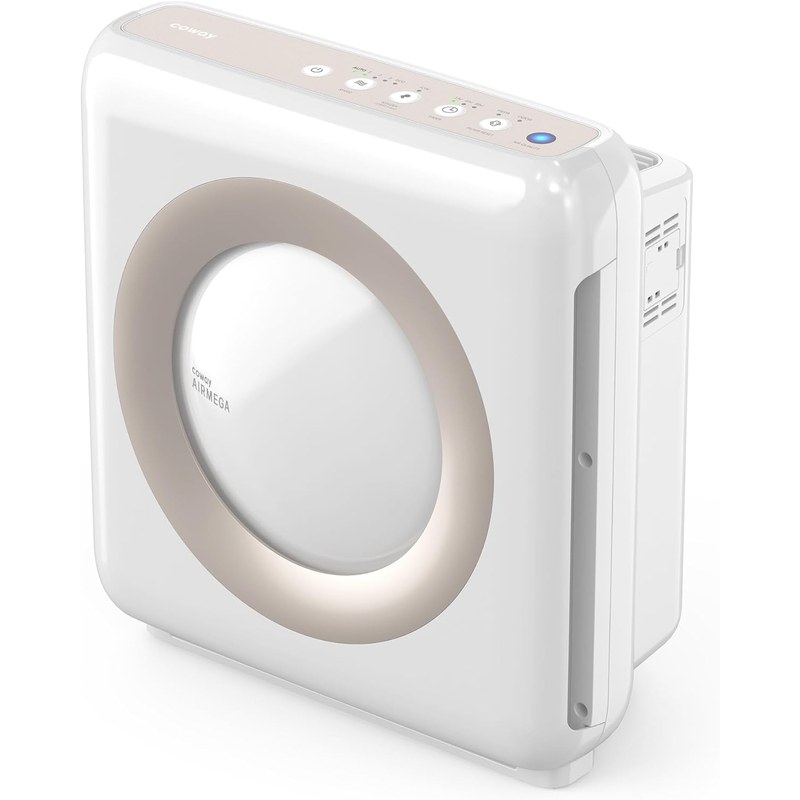
★ 4.6/5 from 29,186 verified Amazon reviews. The Mighty is the sensible default for a litter-box room: a four-stage system – washable pre-filter, deodorization (carbon) filter, bipolar device and a True HEPA filter that captures 99.97% of particles down to 0.3 microns – with the carbon stage doing the actual odor work. The manufacturer states it cleans spaces up to 1,748 sq ft in an hour and reduces VOCs and odor, and its published AHAM-verified CADR of 246 means it moves serious air for a compact unit. Auto mode reads the air quality and adjusts the fan, there's a colour-coded air-quality light you can switch off at night, and filter alerts tell you when to clean or replace.
- Pros
- True HEPA + a real carbon/deodorization stage
- AHAM-verified CADR 246 – strong for its size
- 29,000+ reviews at 4.6 stars – proven over years
- Washable pre-filter cuts running cost; auto mode
- Cons
- Combined filter means carbon and HEPA are replaced together
- Older design – no app or Wi-Fi
Levoit Core 300-P Air Purifier (Pet Edition)
Best Budget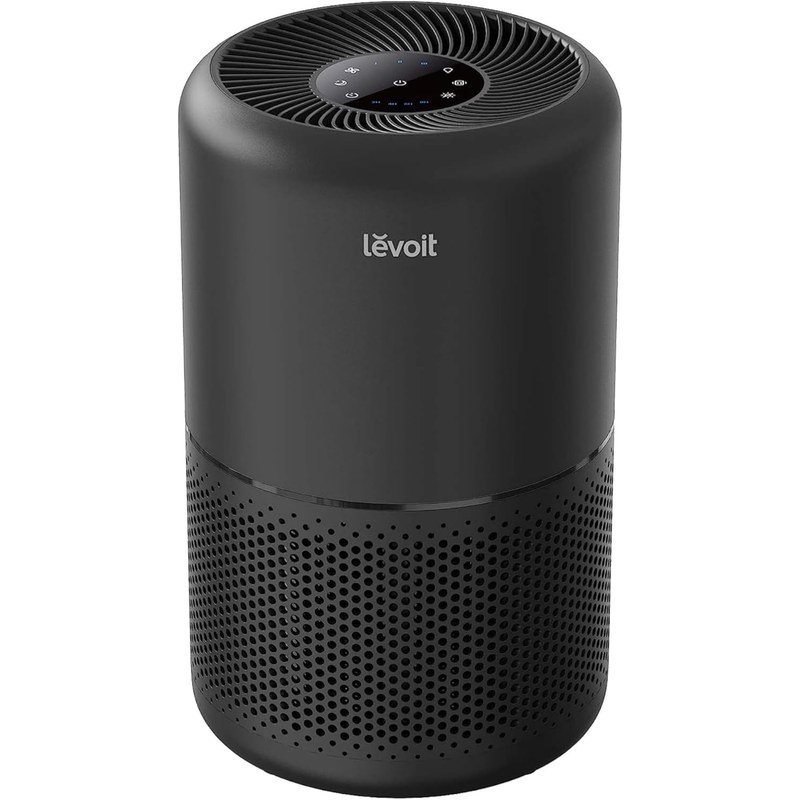
★ 4.7/5 from 108,978 verified Amazon reviews – the highest rating in this round-up. The Core 300-P is the "pet" version of Levoit's best-selling purifier: a 3-in-1 filter with a fine nylon pre-filter, a high-efficiency activated carbon layer and HEPA-grade media that the manufacturer rates for 99.97% of airborne particles from 0.1–0.3 microns. It's AHAM VERIFIDE with a published CADR of 143 CFM for smoke, 153 for dust and 167 for pollen, refreshing a 222 sq ft room about 4.8 times an hour or a 1,073 sq ft space once an hour. There's a swappable Pet Allergy filter option that leans harder into dander and odor, and Sleep mode drops noise to a near-silent 24 dB – useful if the box is near where you sleep.
- Pros
- 108,000+ reviews at 4.7 stars
- AHAM VERIFIDE CADR (143/153/167 CFM)
- Swappable Pet Allergy filter option
- 24 dB sleep mode; low running cost
- Cons
- Small – best for one room, not open plan
- No Wi-Fi on this model (see the 200S-P for app control)
Coway Airmega 250 Air Purifier
Best for Large Rooms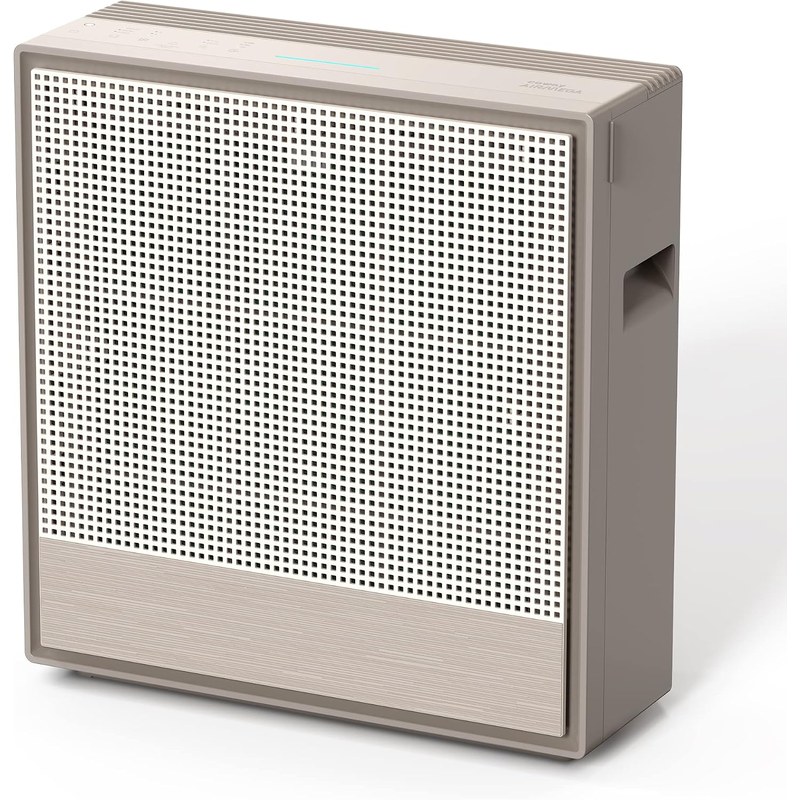
★ 4.5/5 from 809 verified Amazon reviews. When the litter box shares an open-plan living space, coverage is the whole ballgame – and the Airmega 250 is built for it. Coway's HyperCaptive system combines a washable pre-filter, an activated carbon filter and a True HEPA filter (99.97% down to 0.3 microns), and the manufacturer states it reduces 99% of VOCs and odor, not just particles. Coverage is rated at 930 sq ft in 30 minutes or 1,860 sq ft in an hour. A 24/7 air-quality monitor drives Smart Mode (it speeds up automatically when pollution rises) and a Rapid Mode for when you've just scooped. Fewer reviews than the big sellers, but the spec-to-price ratio for a large room is strong.
- Pros
- Huge coverage (930 ft² in 30 min)
- Explicit 99% VOC/odor reduction claim
- 24/7 AQI monitor, Smart + Rapid modes
- Washable pre-filter
- Cons
- Only ~800 reviews so far
- Larger footprint than a bedroom unit
Blueair Blue Pure 311i Max Air Purifier
Best Smart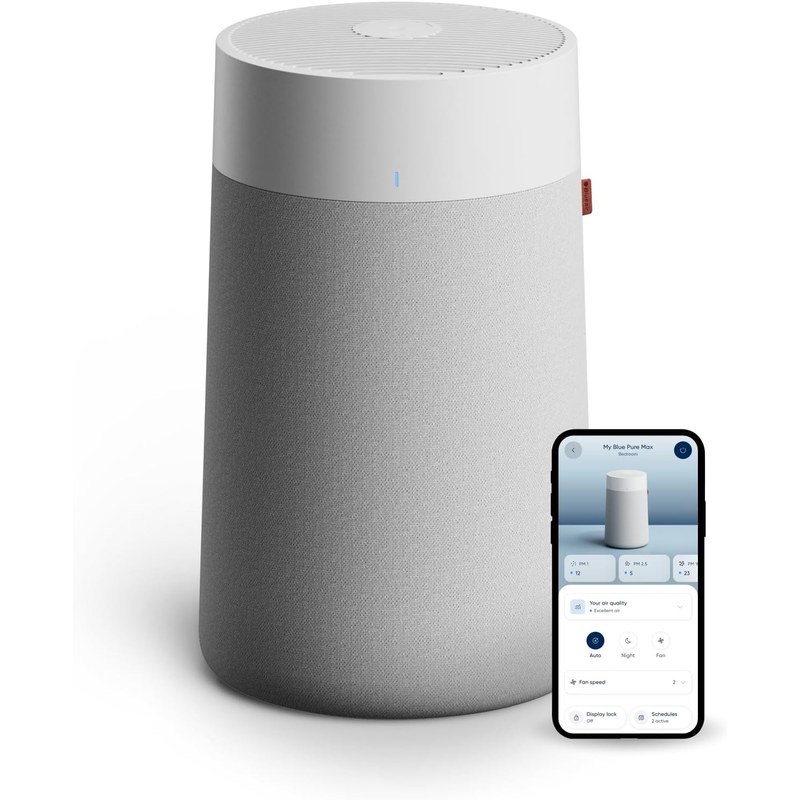
★ 4.5/5 from 2,562 verified Amazon reviews. Blueair's HEPASilent technology uses a mechanical + electrostatic charge to capture 99.97% of particles down to 0.1 microns at low noise and low energy. The 311i Max is the connected, large-room member of the family: it cleans 439 sq ft in about 12.5 minutes or 2,107 sq ft in an hour, and its built-in sensors raise the fan speed automatically when pollution climbs. You monitor air quality, schedule operation and track filter life in the Blueair app. It's QuietMark-certified and runs between 23 and 50 dB, so it's bedroom-friendly, and a washable fabric pre-filter catches cat hair before it reaches the main filter.
- Pros
- Large coverage (2,107 ft² in 1 hr)
- Wi-Fi app control + auto sensors
- Quiet: 23–50 dB, QuietMark-certified
- Washable pre-filter for pet hair
- Cons
- Carbon content is lighter than Coway's dedicated odor stage
- Filter is proprietary
Blueair Blue Pure 511 Air Purifier
Best Compact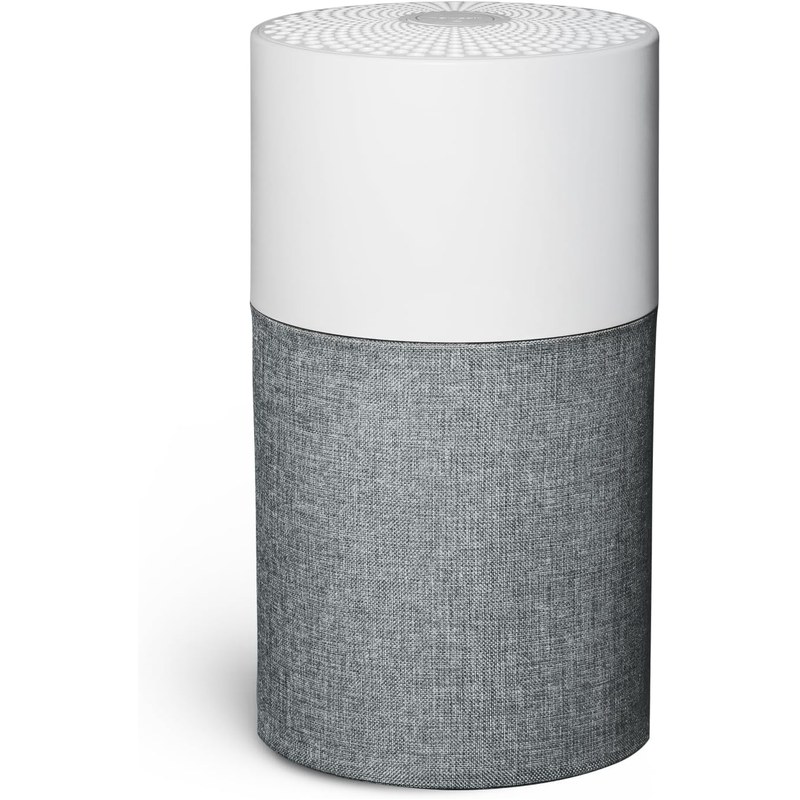
★ 4.4/5 from 3,371 verified Amazon reviews. The Blue Pure 511 is the smallest and quietest way to add filtration right in the litter room – a laundrette-cupboard-sized unit that cleans up to 432 sq ft in 30 minutes (or a 180 sq ft small room in about 12.5 minutes) while running at just 24 dB on low. It uses the same HEPASilent dual filtration as the bigger models, rated to capture 99.97% of airborne particles down to 0.1 microns, and it's certified Energy Star "Most Efficient". A washable pre-filter (included in Arctic Trail grey, with two other colour options) traps fur, and the compact footprint means it tucks into a corner next to the box without dominating the room.
- Pros
- Compact and very quiet (24 dB low)
- HEPASilent 99.97% down to 0.1 microns
- Energy Star Most Efficient; washable pre-filter
- 3,300+ reviews at 4.4 stars
- Cons
- Modest CADR – one room only
- Light carbon layer for heavy odor loads
IQAir GC MultiGas XE Air Purifier
Best for Severe Odor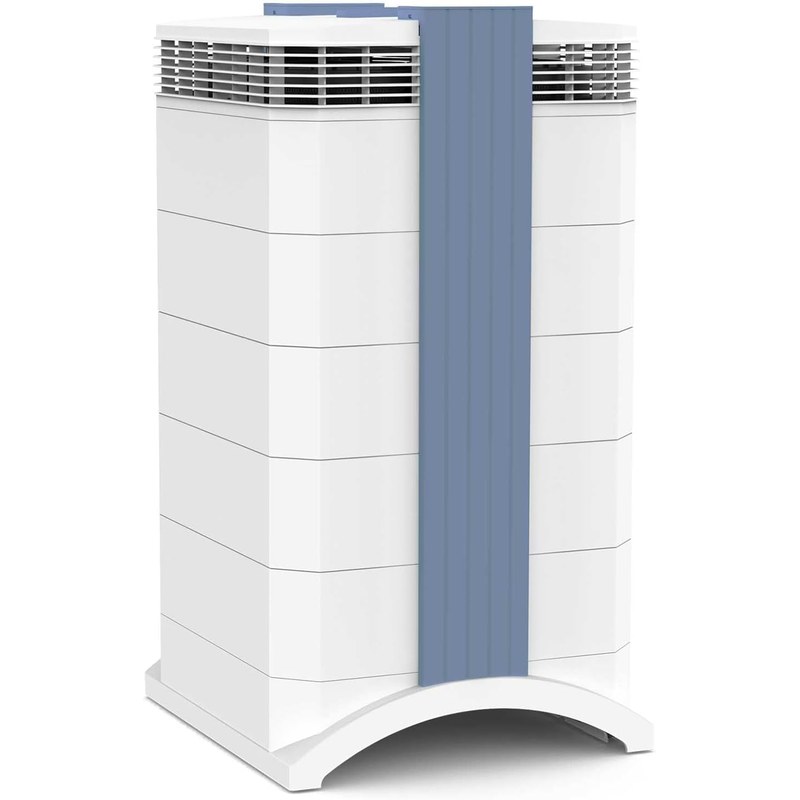
★ 4.3/5 from 1,500+ verified Amazon reviews. If nothing else tames the smell, the GC MultiGas XE is the sledgehammer: instead of a single carbon pad it stacks HyperHEPA filtration, activated carbon, dedicated gas cartridges and post-filter sleeves, and it's designed specifically to capture chemicals, tobacco smoke, odors and airborne contaminants – the manufacturer claims it captures 99% of gases and covers spaces up to 1,125 sq ft. It also removes particles down to an ultra-fine level via HyperHEPA and is app-connected for monitoring. It's made in Switzerland and carries a 10-year limited warranty. It costs far more than the others and is genuinely overkill for a small bathroom – but for a stubborn multi-cat odor in a large living space, it's the most thorough option here.
- Pros
- Multi-gas cartridges – the strongest odor/VOC design here
- HyperHEPA + carbon + post-filter sleeves
- Wi-Fi app; Swiss-made; 10-year limited warranty
- Cons
- Premium price — the most expensive pick
- Bulky floor unit; filter cartridges are a recurring cost
Comparison Table
| Model | Coverage | Filtration | Odor / VOC | Noise | Rating |
|---|---|---|---|---|---|
| Coway AP-1512HH Mighty | up to 1,748 ft² | 4-stage, True HEPA + carbon | Reduces VOCs & odor | — | 4.6 (29,186) |
| Levoit Core 300-P | up to 1,073 ft² | 3-in-1 carbon + HEPA | Carbon layer; Pet filter option | 24 dB sleep | 4.7 (108,978) |
| Coway Airmega 250 | up to 1,860 ft² | HyperCaptive, True HEPA + carbon | 99% VOCs & odor | — | 4.5 (809) |
| Blueair Blue Pure 311i Max | up to 2,107 ft² | HEPASilent dual, 0.1 µm | Washable pre-filter + carbon | 23–50 dB | 4.5 (2,562) |
| Blueair Blue Pure 511 | up to 907 ft² | HEPASilent dual, 0.1 µm | Washable pre-filter + carbon | 24 dB low | 4.4 (3,371) |
| IQAir GC MultiGas XE | up to 1,125 ft² | HyperHEPA + carbon + gas cartridges | Captures 99% of gases | — | 4.3 (1,500+) |
Coverage, filtration, odor and noise figures are the manufacturers' published specifications. Ratings and review counts are from Amazon. Prices change daily – use the links above for the current price.
How to choose an air purifier for litter odor
- Demand carbon, not just HEPA. The single biggest mistake is buying a HEPA-only purifier and expecting it to kill smell. Check the spec sheet for an activated carbon or "deodorization" stage, and prefer models that state a VOC/odor reduction figure.
- Size it to the room, not the box. Look at the manufacturer's coverage number for the room the litter box sits in – a bathroom or small utility room needs far less than an open-plan living space. Oversized is fine (it just runs on low); undersized is not.
- Place it a few feet from the box. Close enough to catch the odor plume, not so close that it sucks up litter dust and hair. Running it 24/7 beats blasting it after each scoop.
- Watch the recurring cost. Carbon saturates faster in a pet home, so plan on replacing the filter every 6–12 months and cleaning a washable pre-filter every 2–4 weeks. A cheap unit with expensive filters is not cheap.
- Keep noise in mind. If the box is near a bedroom, prioritise a unit whose low/sleep mode is under ~25 dB (the Levoit and Blueair models here both qualify).
- Fix the source too. The best purifier is doing less work when the litter clumps well, the box is scooped daily and the room is ventilated. Pair this guide with a good odor-control litter, a deodorizer and, if you have one, a self-cleaning box.
FAQ
Do air purifiers actually remove cat litter smell?
Yes – if they contain activated carbon. HEPA filters trap the airborne particles that carry odor, but the smell itself comes from gases such as ammonia (urine) and sulfur compounds (feces). Activated carbon adsorbs those gases, so for litter odor you want a unit with both True HEPA and a genuine carbon filter, not HEPA alone.
What type of filter removes cat urine odor?
Activated carbon (also listed as a deodorization filter) is what neutralizes urine ammonia and other odors; HEPA alone does not. Look for a unit that lists a carbon/deodorization stage alongside True HEPA, and prefer models that claim VOC or odor reduction – for example Coway's HyperCaptive system or IQAir's multi-gas cartridges.
How close should an air purifier be to the litter box?
Place it a few feet from the box, not right against it, so it can pull the odor plume in without drawing litter dust straight into the intake. Running it on the same side of the room and leaving it on 24/7 gives far better results than switching it on only after the smell builds up.
How often do I change the filter in a pet-odor air purifier?
Most manufacturers recommend replacing the combined HEPA/carbon cartridge every 6–12 months and cleaning any washable pre-filter every 2–4 weeks. In a busy multi-cat home with a strong odor load the carbon saturates faster, so expect the shorter end of that range.
Bottom Line
For most litter-box rooms, the Coway AP-1512HH Mighty is the easiest recommendation: proven carbon-plus-HEPA filtration, AHAM-verified CADR of 246, an auto mode and 29,000+ reviews behind it. Budget buyers should look at the Levoit Core 300-P, which adds a dedicated pet-odor carbon layer and a 24 dB sleep mode for less. If the box lives in a big open-plan space, the Coway Airmega 250 and Blueair Blue Pure 311i Max move far more air; for a small room the Blueair 511 is the discreet pick. And when odor simply won't quit, the IQAir GC MultiGas XE brings multi-gas cartridges to the fight.
The rule stays simple: carbon beats HEPA-only for smell, size the unit to the room, and run it continuously. A purifier is a partner to good litter and daily scooping – not a replacement for them.