Scooping a litter box twice a day is the chore almost every cat owner dreads – the smell, the clumping litter dust, the 6 a.m. wake-up call that comes from a cat refusing to step into a box that was used an hour ago. Self-cleaning litter boxes promise to end that routine. Some of them actually deliver.
We analyzed the most popular self-cleaning litter systems of 2026: comparing mechanisms (disposable crystal trays vs. motorized scooping units), upfront prices, annual running costs, and owner satisfaction across more than 30,000 verified Amazon reviews. What we found is that a famous brand name does not guarantee a good rating – and that the cheapest "system" in our list is also the most loved.
| Product | Key Benefit | Price Range | Link |
|---|---|---|---|
| PetSafe ScoopFree Disposable Crystal Litter Tray | Best Budget System | $20–30 (9-pack) | Check Price |
| Neakasa M1 Plus Open-Top Self-Cleaning Litter Box | Best Odor Control | $400–500 | Check Price |
| PetSafe ScoopFree OpenSky Self-Cleaning Litter Box | Best Open-Top | $300–400 | Check Price |
| PetCove IronPaws Stainless Steel Enclosed XL Litter Box | Best Enclosed XL | $80–120 | Check Price |
Why Self-Cleaning Litter Boxes Are Worth It
Let's be honest about the problem first. A standard litter box needs scooping at least once a day – twice in multi-cat households. Miss a day and three things happen: the box smells, your cat starts looking for alternative spots, and the chore gets worse the longer you postpone it. That daily ritual is the single biggest reason people give up on conventional boxes.
Odor is the second reason. Waste that sits in an open tray releases ammonia fumes within hours, especially in warm rooms. Crystal tray systems absorb urine into silica crystals and dry out solid waste, which changes the game entirely: there is simply less moisture and less air exposure for bacteria to work with. Motorized boxes address the same problem mechanically by moving waste into a sealed bin within minutes of the cat leaving.
Multi-cat households benefit most. Veterinarians generally recommend one box per cat plus one extra, which means three boxes for two cats – and that is a lot of scooping. A reliable self-cleaning system can cover the equivalent workload with a fraction of the effort, and cats that consistently find a clean box are noticeably calmer. The flip side: some cats are wary of motorized units, which is why we treat owner reviews, not marketing claims, as the deciding factor in our rankings.
How They Work: Crystal Trays vs. Mechanical Sieves
There are two fundamentally different approaches on the market, and understanding them explains almost every price and rating difference you will see.
Crystal tray systems (like the PetSafe ScoopFree family) use a disposable tray pre-filled with silica crystal litter. Urine is absorbed and trapped by the crystals, solid waste is dried out by the low humidity, and when the tray is full you throw the whole thing away and click in a fresh one. The companion ScoopFree box sweeps solid waste into a covered compartment automatically. There is no scooping, no clumping litter, and virtually no dust. The trade-off is an ongoing cost for the trays themselves.
Mechanical boxes (like the Neakasa M1 Plus or the ScoopFree OpenSky) are self-contained units with a motorized rake, roller or sifting mechanism that separates waste from regular clumping litter and drops it into a sealed waste bin. They run on standard litter, cost more upfront, and need electricity. They also depend heavily on litter quality: cheap or poorly clumping litter can defeat even the most expensive mechanism.
The Real Cost of Hands-Free
The price tag on the box is only the entry ticket. Before you buy, work out the running costs – this is where owners are most often surprised.
Crystal trays cost roughly $2.50–3.50 each, and one tray typically lasts one to two weeks for a single cat. That adds up to about $90–150 per year for one cat, and the cost scales with every additional cat. It is a subscription in all but name – but it buys genuinely zero scooping and zero dust.
Mechanical boxes avoid proprietary refills but need decent clumping litter, which runs about $120–180 per year depending on the brand, plus occasional deep cleaning and the occasional replacement part. The OpenSky is notable here: it works with any litter, so you are never locked into a proprietary consumable – but at $300–400 you are paying a premium for a unit whose owner satisfaction is, as we will see, the lowest in this comparison.
How We Analyzed & Compared
- Specs & manufacturer data: mechanism type, tray or litter compatibility, size, included accessories
- Owner satisfaction: aggregated ratings from 32,600+ verified Amazon reviews across the four systems
- Running costs: tray refill prices, clumping litter consumption, filter and carbon pad replacements per year
- Honesty filter: we flag low satisfaction even when the brand is famous – nobody gets a pass on ratings
The 4 Best Self-Cleaning Litter Boxes
PetSafe ScoopFree Disposable Crystal Litter Tray
Best Budget System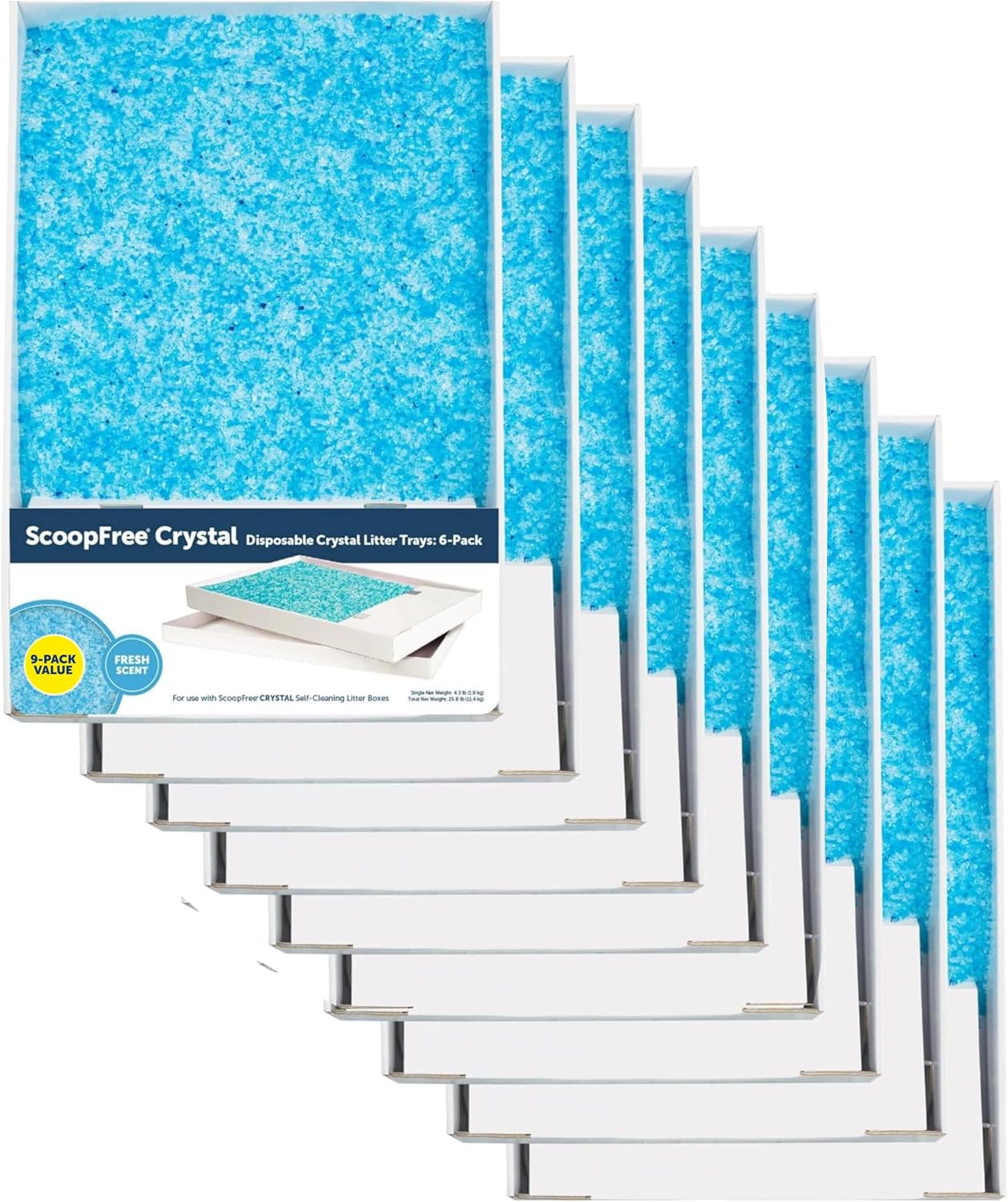
- Material
- Crystal
- Price range
- $20–30 (9-pack)
★ 5.0/5 from 22,941 verified Amazon reviews. This is the consumable heart of the PetSafe ScoopFree system – and the highest-rated product in our entire analysis. Each tray is pre-filled with crystal litter: urine is absorbed and trapped in the crystals, solid waste dries out, and when the tray is spent you lift it out and click in a fresh one. Combined with the ScoopFree automatic box, it is the closest thing to a truly hands-free setup at a budget price. With nearly 23,000 reviews and a perfect star rating, the owner data here is simply overwhelming.
- Pros
- 5.0★ from 22,941 reviews – the most trusted product in this roundup
- Zero scooping and no litter dust, ever
- Trivial maintenance: just swap the tray every 1–2 weeks
- Low upfront cost – the box is the only big purchase
- Cons
- Recurring tray cost of roughly $90–150 per year
- Single-use trays produce ongoing plastic waste
- Not a standalone box – requires the ScoopFree unit
Neakasa M1 Plus Open-Top Self-Cleaning Litter Box
Best Open-Top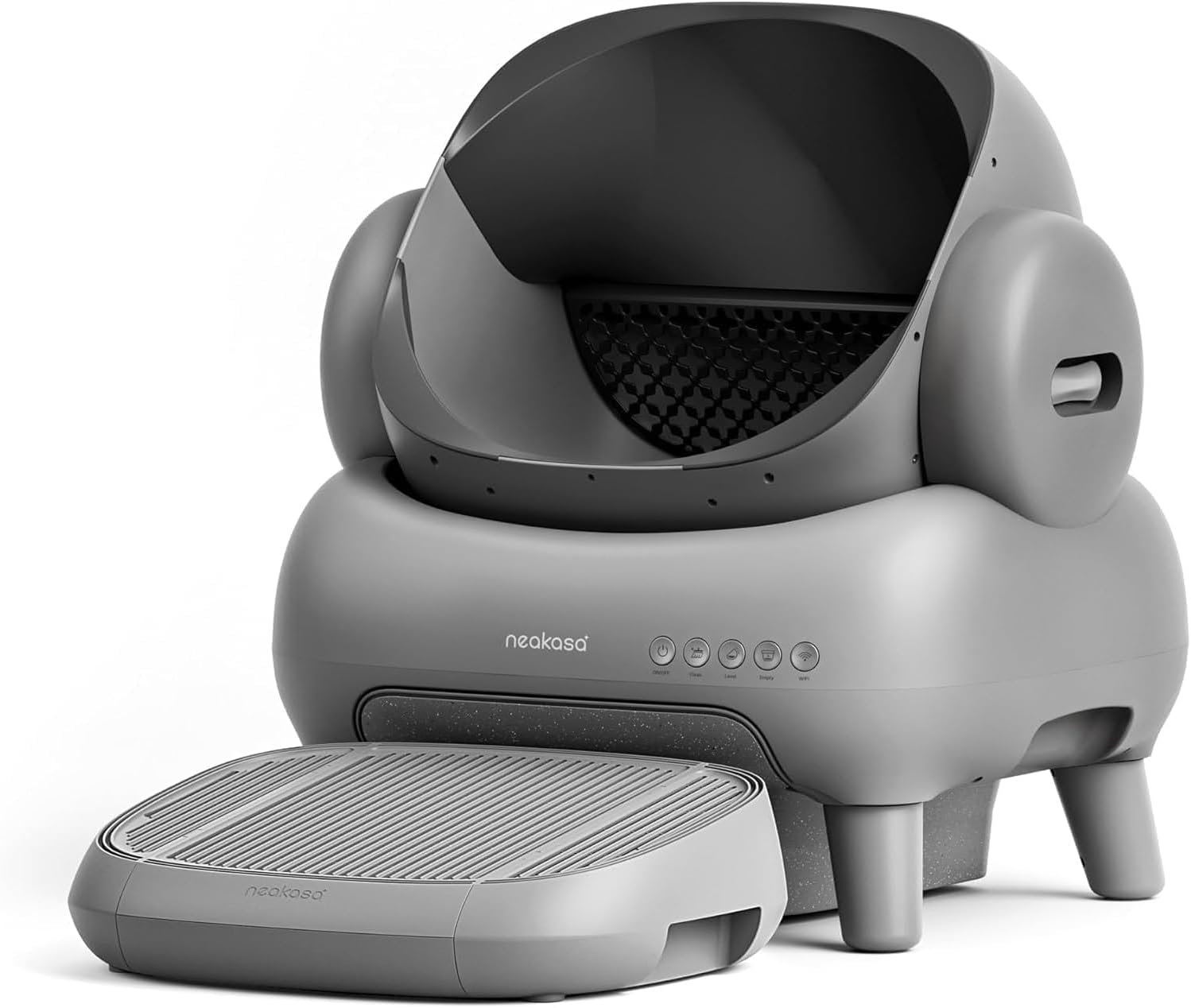
- Features
- Self-cleaning
- Price range
- $400–500
★ 4.4/5 from 4,296 verified Amazon reviews. The high-end pick in our analysis, and the one owners rate highest among the fully automatic units. The open-top design is its biggest selling point: unlike enclosed tunnels, there is no ceiling mechanism above the cat, which suits larger cats and skittish cats that refuse enclosed boxes. The automatic cycle separates waste from clumping litter and drops it into a sealed bin, and the included pedal step stool with filter function reduces tracking. At $400–500 it is an investment – but with a 4.4★ average across more than 4,000 reviews, it is the automatic box with the strongest owner data in this comparison.
- Pros
- 4.4★ from 4,296 reviews – best-rated automatic unit here
- Open-top design suits large cats and box-averse cats
- Automatic cleaning with a sealed, odor-containing waste bin
- Included pedal stool with filter function
- Cons
- Premium price of $400–500
- Demands quality clumping litter to work well
- Large footprint – needs floor space
PetSafe ScoopFree OpenSky Self-Cleaning Litter Box
Best Odor Control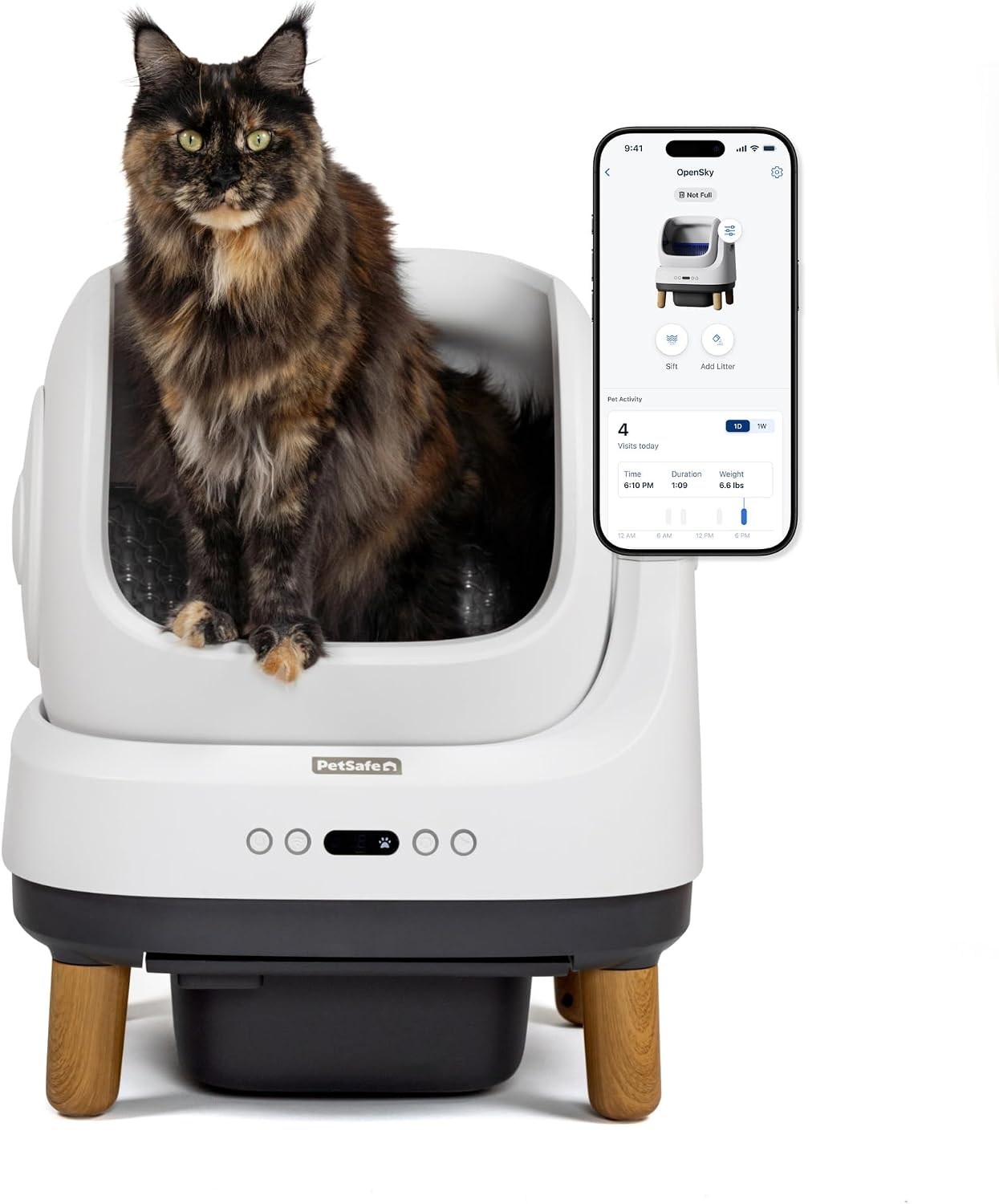
- Features
- Self-cleaning
- Price range
- $300–400
★ 3.3/5 from 4,296 verified Amazon reviews. We are including this for a reason, and it is not a flattering one. On paper the OpenSky has everything: app control, health monitoring, compatibility with any litter, and a promise of up to two weeks of hands-free cleaning. In practice, its 3.3★ average is the lowest owner satisfaction in our entire comparison – and the badge on the box says "advanced odor control," yet odor containment is exactly what owners complain about most. Given the $300–400 price and the ScoopFree ecosystem's premium positioning, we honestly cannot recommend it ahead of the systems above. The one genuine bright spot: because it works with any litter, you are never locked into proprietary refills.
- Pros
- App control with health monitoring
- Works with any litter – no proprietary refills
- Claims up to 2 weeks of hands-free cleaning
- Cons
- 3.3★ – the lowest owner satisfaction in our analysis
- Odor control does not live up to the "advanced" claim
- Premium $300–400 price for a mixed owner experience
PetCove IronPaws Stainless Steel Enclosed XL Litter Box
Best Enclosed XL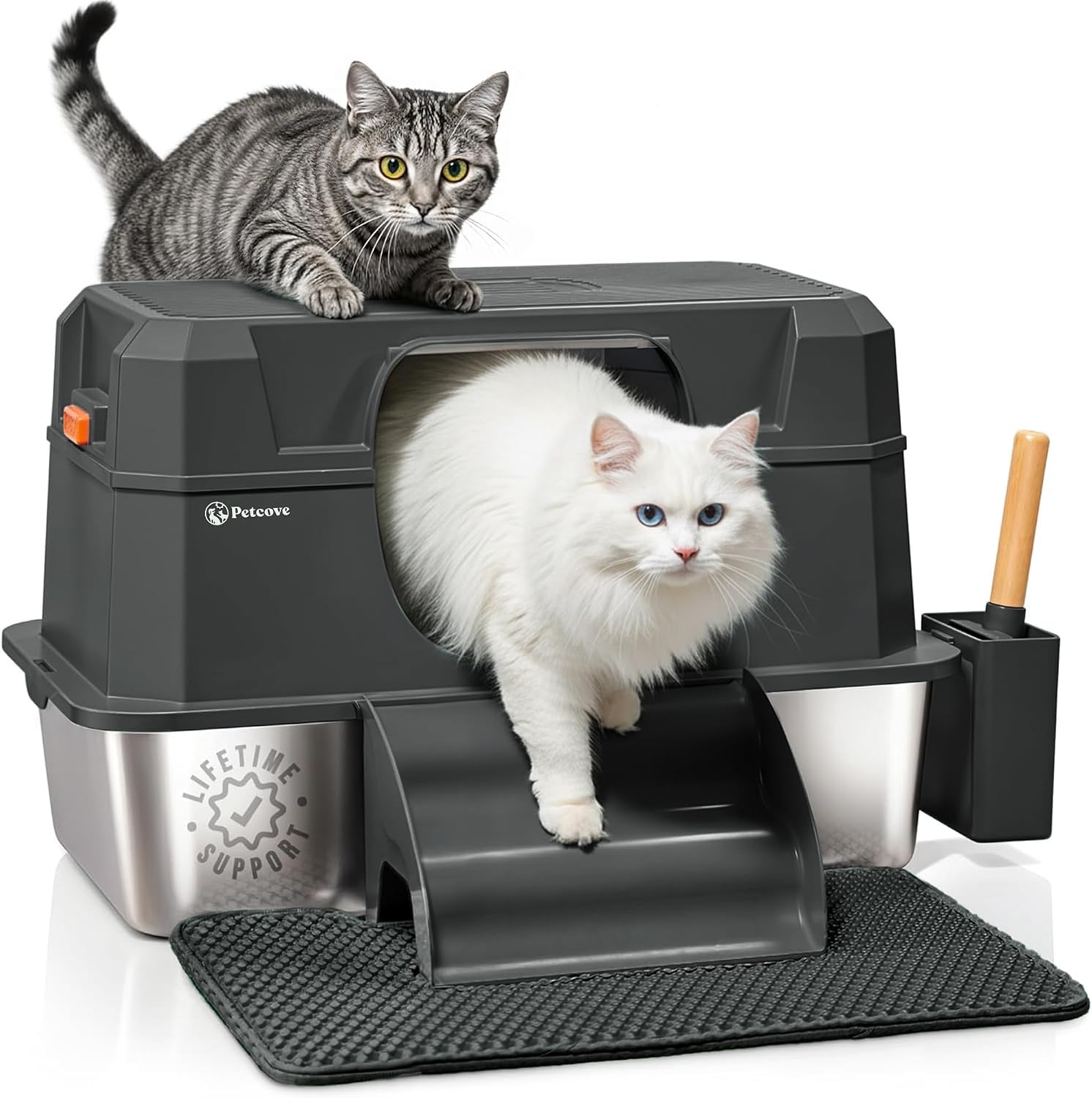
- Material
- Stainless steel
- Price range
- $80–120
★ 4.5/5 from 1,067 verified Amazon reviews. Full transparency: this one does not clean itself. It earns its place in this roundup because for many households the real enemy is odor and litter tracking, not the scooping itself. The IronPaws XL is a stainless steel enclosed box with an activated carbon odor eliminator, a lid, steps, a mat and a scoop included – a complete 3-in-1 kit. Stainless steel is non-porous, easy to disinfect and naturally odor-resistant, and the XL interior comfortably fits large breeds. At $80–120 it costs a fraction of an automatic unit, and its 4.5★ rating from over a thousand reviews shows strong owner satisfaction. If you want the odor control of an enclosed system without electronics – or a sturdy second box for a multi-cat home – this is the honest, sensible pick.
- Pros
- 4.5★ from 1,067 verified reviews
- Stainless steel – hygienic, non-porous, odor-resistant
- XL size fits large cats; complete kit incl. steps, mat & scoop
- No power, no sensors, no app – nothing to break
- Cons
- Not actually self-cleaning – still needs daily scooping
- Activated carbon filter adds small recurring cost
- Enclosed design may not suit every cat
Comparison Table
| Model | Price | Type | Running cost / year | Best for |
|---|---|---|---|---|
| ScoopFree Crystal Tray (9-pack) | $20–30 | Crystal tray refills | ~$90–150 (trays) | Budget & low-effort |
| Neakasa M1 Plus | $400–500 | Automatic open-top | ~$120–180 (litter) | Premium / large cats |
| ScoopFree OpenSky | $300–400 | Automatic enclosed + app | ~$120–180 (any litter) | App & health monitoring |
| IronPaws XL | $80–120 | Enclosed manual stainless | ~$60–100 (litter + filters) | Odor control, no electronics |
Buying Guide: How to Choose
Crystal trays vs. mechanical boxes
Decide which trade-off you can live with. Crystal trays mean a low upfront price, zero scooping, zero dust, and simple tray swaps – but a steady annual cost and single-use waste. Mechanical boxes mean one large purchase, ongoing clumping litter, and a mechanism that can break – but no proprietary consumables. If the review data is any guide, the crystal tray approach has the happiest owners by far.
Running costs: the refills are the real price
Always calculate the first year of ownership: box price plus consumables. A $300 box with $150 in annual trays can cost more in year one than a $450 box with ordinary litter. And remember that the cheapest possible litter usually defeats the most expensive mechanism – budget for mid-range clumping litter if you go automatic.
Size: big cats need open-top or XL
Enclosed tunnel designs make many large cats feel trapped, and a cat that refuses the box will use your floor instead. The Neakasa M1 Plus solves this with its open-top design; the IronPaws XL offers a roomy alternative without electronics. Measure your cat before you measure the box – a box that is too small is a failed purchase regardless of features.
Odor management: what actually works
Three things control smell: rapid waste removal, moisture control, and cleaning. Crystal trays handle moisture absorption automatically; mechanical boxes depend on the cycle running promptly and on sealed waste bins. Our data shows the marketing claim "advanced odor control" means little – the OpenSky's 3.3★ rating says it all. Trust review averages over box art.
Power outage safety
Mechanical boxes stop cycling when the power goes out. That is usually fine – the box still works as a manual box until power returns – but it is worth knowing that a crystal tray system keeps working through an outage with zero electricity. If you live somewhere with frequent outages, that is a real advantage of the tray approach.
FAQ
Are self-cleaning litter boxes safe for cats?
Yes, when the unit is working correctly. Modern mechanical boxes use sensors to stop the cleaning cycle as soon as a cat enters. Open-top designs add an extra layer of safety because there is no mechanism above the cat. Introduce any new box gradually, and keep a manual box available during the transition – some cats need a week or two to accept an automatic unit.
How often do you need to change crystal litter?
With ScoopFree-style trays, roughly every 1–2 weeks per cat. Stir the crystals daily so urine spreads through the litter, remove solid waste promptly, and replace the tray once the crystals are saturated or the odor control drops off. Because you swap the entire tray, there is no scooping involved – which is exactly the point.
Do self-cleaning litter boxes really eliminate odor?
The crystal tray approach has the strongest track record: the ScoopFree tray holds a 5.0★ average from 22,941 reviews. Mechanical boxes can contain odor well with a sealed waste bin and quality clumping litter, but the owner data shows it is not guaranteed – the OpenSky's "advanced odor control" claim collides with a 3.3★ average. Judge by review data, not by marketing.
How much do self-cleaning litter boxes cost to run per year?
Crystal tray systems run about $90–150 per year for a single cat, mostly in tray refills. Mechanical boxes need clumping litter, typically $120–180 per year, plus occasional parts or filters. Add the upfront box price and you get the true first-year cost – that is the number that should drive your decision.
Bottom Line
If you want the best compromise between price and everyday practicality, the PetSafe ScoopFree crystal tray system is our top recommendation – 5.0★ from 22,941 verified reviews, zero scooping, and an honest, predictable running cost. If you want a premium automatic box with the strongest owner data among motorized units, the Neakasa M1 Plus is the one to buy. The ScoopFree OpenSky is the cautionary tale: a feature-packed box whose 3.3★ rating shows that features do not equal satisfaction. And the IronPaws XL remains the smart low-tech pick for odor-sensitive households that don't mind scooping.
Whatever you choose: calculate the first-year cost before you buy, trust verified review averages over marketing claims, and never force a nervous cat into a new system. A box your cat actually uses beats a clever box they avoid.