Your cat lives entirely indoors. Apartment walls, a sunny windowsill, maybe a balcony with a good view. So why would you need a GPS tracker? The short, honest answer: for most indoor cats, you don't. The internet is full of articles telling every cat owner to buy a $70 tracker with a $10-a-month subscription – even for cats that never set a paw outside. That advice is wrong for most indoor cats, and we'll tell you exactly when it isn't.
We analyzed the trackers that could make sense for an indoor cat the same way we built our full GPS guide: technical specs, manufacturer data, and feedback from 21,000+ verified Amazon owner reviews. The result is deliberately short: of the six trackers in our complete analysis, exactly three are worth considering for an indoor cat. Everything else is money you can keep.
| Product | Key Benefit | Price Range | Link |
|---|---|---|---|
| AirTag Cat Collar with Hidden Holder & Bell | Best for Most Indoor Cats | $30–50 (+ AirTag) | Check Price |
| Tractive Smart Cat GPS Tracker | Best for Balcony Cats | $60–80 | Check Price |
| Pet GPS Tracker Collar for Cats & Small Dogs | No-Subscription Alternative | $90–130 | Check Price |
How We Selected & Compared
For indoor cats, a "tracker" means something different than for outdoor cats – so we judged these devices on the criteria that actually matter when your cat never leaves the house:
- Tracking technology: GPS vs. Wi-Fi/BLE-based – and whether it works indoors at all
- Accuracy: how precisely it locates your cat inside your home or garden
- Battery life: real-world longevity between charges
- Honest cost: purchase price plus any subscription over two years
- Owner satisfaction: aggregated ratings from 21,000+ verified Amazon reviews
Do Indoor Cats Need a GPS Tracker? The Honest Answer
Most of the time: no. A GPS tracker finds a cat that goes somewhere you can't see – and an indoor cat's entire world is your apartment. If your cat never gets out, a tracker solves a problem you don't have; buying one, especially with a subscription, is usually money down the drain. That's the honest bottom line, and it's the first thing most articles in this niche won't tell you.
There are, however, situations where a strictly indoor cat can disappear – and a tracker changes the outcome from "worried for days" to "found in an hour." If one describes your cat, keep reading:
- Balcony or terrace access. Balcony cats are indoor cats with an escape route. Cats slip through railings, squeeze past screens, or jump after a bird. A fall is a medical emergency, and a scared cat that lands outside will bolt. This is the most common reason an "indoor" cat genuinely benefits from a tracker.
- An escape artist. Some cats are door-dashers: the door opens for a delivery and the cat is gone. Most bolt indoors and hide; a few make it outside. Done once, they'll do it again.
- A move to a new home. A cat in a new apartment is disoriented and more likely to bolt while doors are open or movers are around. If they get out, they hide instead of coming back – they don't know where "home" is.
- A former outdoor or stray cat. If your rescued cat used to roam, the outdoor instinct doesn't switch off at the front door. Some adapt quickly; others test doors and windows for months. A tracker is cheap insurance during that transition.
- Vet visits and travel. A cat spooked at the vet can wriggle out of the carrier in the parking lot. In an unfamiliar area, a tracker is the difference between searching the whole neighborhood and walking straight to their hiding spot.
Escape Scenarios: When an Indoor Cat Actually Gets Out
"Indoor cat" is a lifestyle, not a guarantee. Cats don't decide to be indoor cats – we do – and a few predictable moments can override that decision in seconds. None of these are reasons to panic; they're reasons to know your plan before they happen. Here are the situations that actually lead to an indoor cat getting out, and what a tracker can and can't do in each.
Moving house
A move is the single highest-risk event for an indoor cat: new sounds, new smells, strangers carrying boxes, and doors propped open for hours. A cat that bolts during a move rarely runs far – but they also don't know where "home" is yet, so they hide instead of returning. If you're moving, keep your cat in one closed room with a note on the door. If your cat wears a tracker, this is the week to have it charged and your safe zone updated to the new address.
Open windows and damaged screens
An unlocked window or a screen with a torn corner is an open door to a cat. It's the most common accidental escape – nobody "let the cat out," the cat let itself out while you slept. A tracker helps mostly after the fact: an AirTag or Find My collar shows you which neighbor's garden or stairwell your cat slipped into. The lasting fix is a window screen lock, not a gadget.
Visitors and delivery workers
Guests, cleaners and couriers hold doors open longer than you do. A quiet, curious cat can walk past unnoticed, and the visitor has no idea they let a cat out. This is where a cheap ID tag and a tracker both earn their keep: the tag gets a stranger to call you, and the tracker tells you the cat made it out at all.
Multi-cat households darting past
With more than one cat, doorways become a race. One cat bolts out, a second follows the first, and by the time you look up, two cats are missing. A tracker on the escape-prone cat – usually the youngest, or a former stray – narrows the search fast, especially in an apartment building where you're checking several floors.
Fire alarms, storms and panic
Loud alarms, thunder and fireworks send even the calmest indoor cat sprinting for cover – sometimes straight through an open door. Panic escapes are the hardest to predict, and they're where a last-known pin matters most: a terrified cat won't come when called and may travel further than usual.
Vet-carrier mishaps
A cat that panics in a car park can slip a carrier latch or bolt from your arms in an unfamiliar neighborhood. In this scenario a live GPS tracker beats a Find My tag, because there are no familiar Apple devices and no "home" to run toward. It's one of the few indoor-cat situations where cellular tracking genuinely outperforms Bluetooth.
The pattern across all of these: escapes happen at doorways and windows, and the cat usually hides nearby rather than running. That's exactly the scenario an AirTag collar is built for – and the reason a cheap, no-subscription tracker is enough for most indoor cats. (If you're weighing the two technologies, our Tractive vs. AirTag comparison walks through the choice.)
The 3 Trackers Worth Considering for Indoor Cats
Our filter: light enough for a cat, safe on a breakaway collar, and no subscription unless the cat genuinely roams. Three products passed: two recommendations, one alternative for subscription-refusers.
AirTag Cat Collar with Hidden Holder & Bell
Best for Most Indoor Cats
- Price range
- $30–50
- Subscription
- None – uses Apple Find My
★ 4.3/5 from 12,802 verified Amazon reviews – by far the most-reviewed option in this analysis. This is not a GPS tracker in the strict sense: it's a breakaway collar with a hidden holder for an Apple AirTag, which you buy separately (around $29–35). Instead of GPS and cellular, it uses Apple's Find My network – whenever your cat is near any iPhone, iPad, or Mac, the AirTag's location quietly updates to your phone. The classic scenario for indoor cats is escape-and-hide: the cat slips out a door, spooks, and hunkers down in a stairwell or a neighbor's garden. In any built-up area, an escaped cat passes an Apple device within minutes – and you know exactly where to look. No subscription, no charging, about a year of battery from a roughly $5 coin cell. The honest limits: no live real-time tracking between Apple-device encounters and little coverage in rural areas.
- Pros
- Cheapest complete setup by far (collar + AirTag)
- No subscription, ever – Apple's Find My network is free
- Coin-cell battery lasts about a year, no charging
- Reflective breakaway collar with hidden AirTag holder
- Cons
- AirTag not included – add ~$29–35
- No real-time location between Apple-device encounters
- Useless in areas with no iPhones nearby
Tractive Smart Cat GPS Tracker
Best for Balcony & Outdoor-Access Cats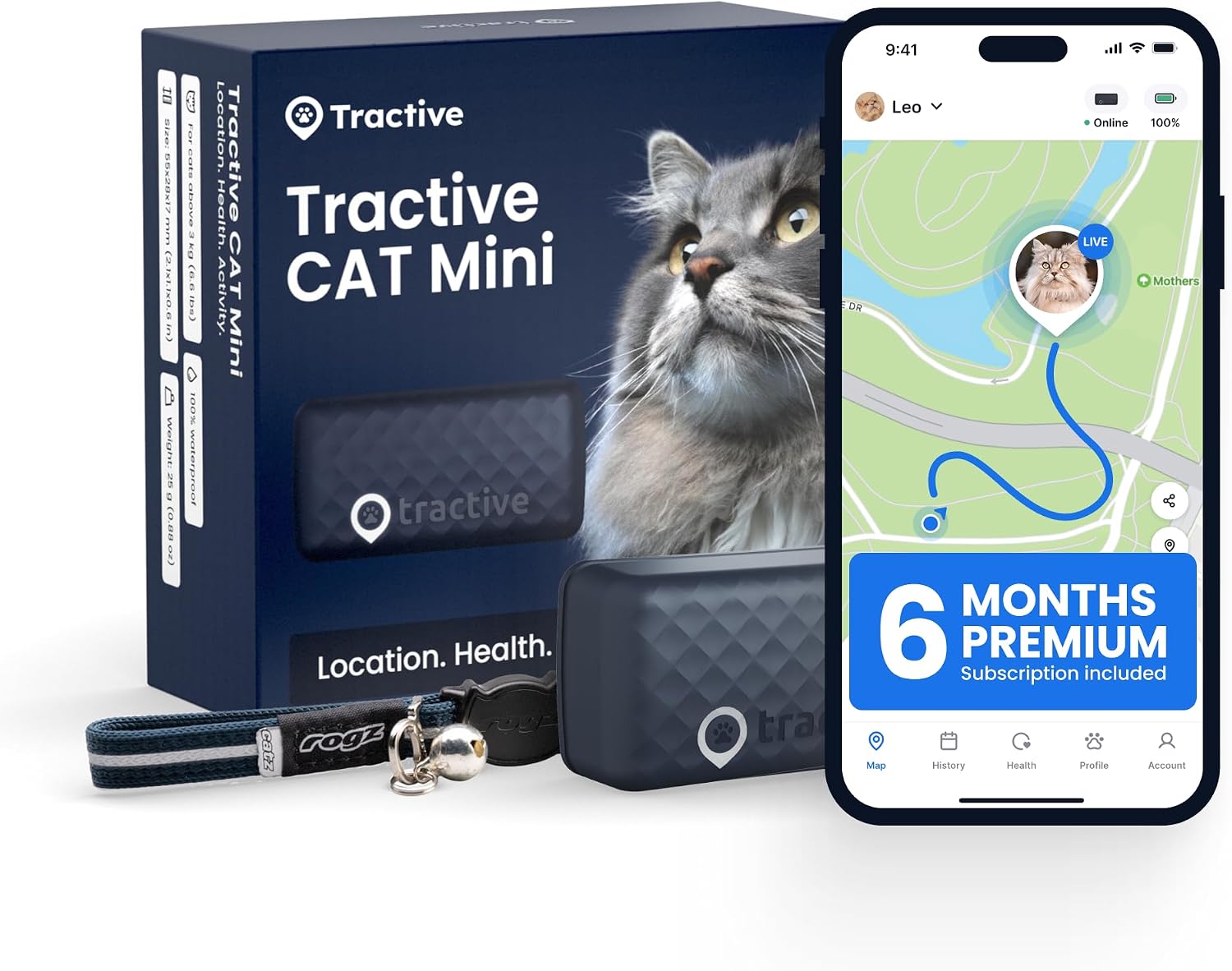
- Price range
- $60–80
- Subscription
- 6 months included, then required
★ 3.8/5 from 3,493 verified Amazon reviews. If your cat has balcony access or regularly gets outside, this tracker does what a tracker should: live real-time location, territory history, activity and wellness monitoring, and a geofence that alerts you the moment your cat leaves a safe zone. It's lightweight (around 13 g) and purpose-built for cats 6.5 lbs and up. The honest caveats are the same ones its 3.8★ average reflects: after the 6-month subscription included in the price, a paid plan is mandatory – the tracker stops working without it – and owners report battery life shorter than the advertised 5 days, so a regular charging routine is required. For a balcony cat, that live tracking and escape alert can be worth it; for a cat that never goes outside, it's a subscription for a map of your living room. (A version with breakaway collar included is also available.)
- Pros
- True live GPS with real-time location updates
- Geofence escape alerts – ideal for balcony cats
- Territory history + activity and wellness monitoring
- Lightweight and purpose-built for cats 6.5 lbs+
- Cons
- Mandatory subscription after the 6 free months
- 3.8★ average – owners report battery shorter than advertised and app issues
- Recharging every few days is a real routine
Pet GPS Tracker Collar for Cats & Small Dogs
No-Subscription Alternative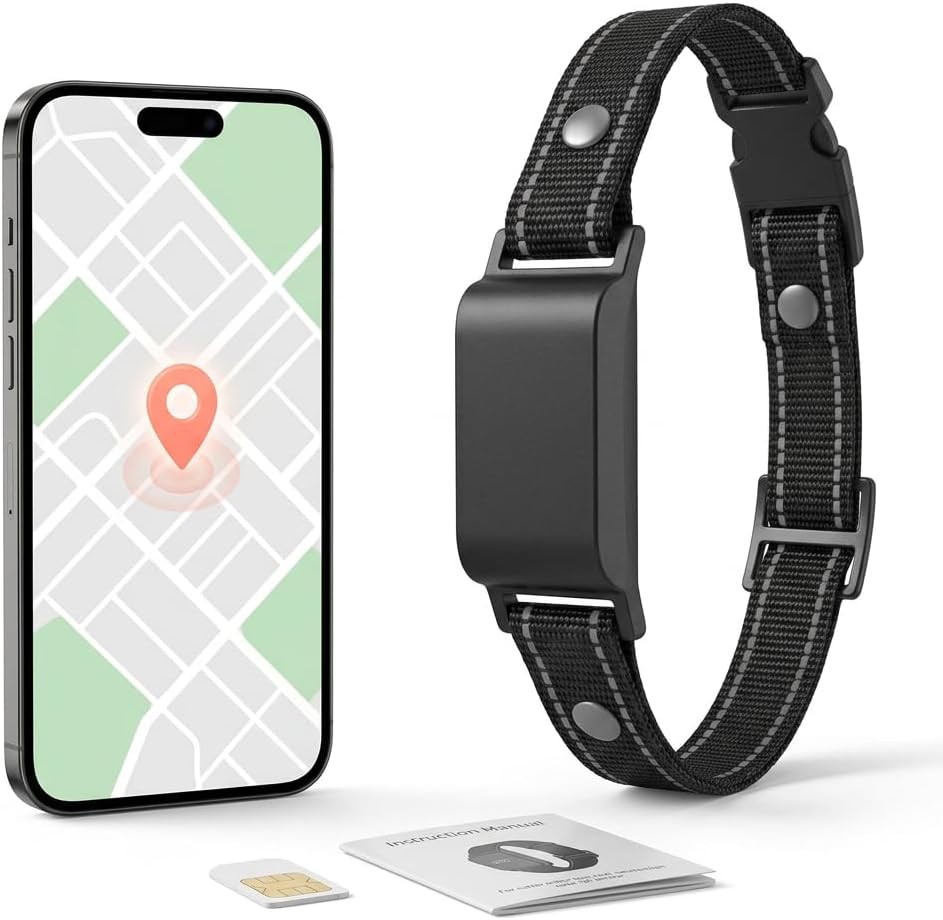
- Price range
- $90–130
- Subscription
- 1 year included – no monthly fees
★ 5.0/5 from 4,967 verified Amazon reviews – the highest-rated product in this analysis. If your balcony cat needs real GPS tracking but you refuse monthly plans, this is the honest middle ground: 1 year of service included, no monthly fees. You pay once and get real-time GPS, geofence alerts, waterproofing, and activity tracking for the first 12 months. Two honest checks before you buy: the service model after year one (not stated in the title – verify in the listing), and the collar's weight and fit. Larger cats are the sweet spot; small cats are better off with the AirTag collar above.
- Pros
- 1 year of service included – no monthly fees
- Perfect 5.0★ average from nearly 5,000 verified reviews
- Real-time GPS and geofence alerts without a subscription in year one
- Waterproof collar design
- Cons
- Higher upfront price than trackers with a free trial
- Service terms after year one aren't in the title – check the listing
- Bulkier than micro trackers; best for larger cats
What about the other trackers from our full analysis? The LandAirSea 54 is excellent for vehicles and luggage, but at roughly 66 g with a required subscription it's wrong for an indoor cat in every dimension. The Averia Collar is well-reviewed but marketed for dogs, its service terms aren't stated in the listing, and activity tracking is overkill for a cat that lives in one apartment. Both are covered in our complete GPS tracker guide.
What to Look For in a Tracker for an Indoor Cat
Weight: under 30 g is the sweet spot
A tracker your cat feels is a tracker your cat will fight. Aim for under 30 g total: the Tractive sits around 13 g, an AirTag adds about 11 g. At 60+ g, you're in small-dog territory.
Safety: a breakaway collar is non-negotiable – indoors too
Indoor cats get hung up too: door handles, gaps behind furniture, window cords. A breakaway (safety) collar unclips under pressure so your cat can never strangle themselves. Both the AirTag collar and the Tractive bundle include one – never mount a tracker on a fixed collar.
Subscription: for indoor cats, prefer zero
The recurring plan is the biggest hidden cost here. For a cat that rarely leaves the apartment, $10 a month makes little sense. The AirTag route costs nothing monthly, forever; the Pet GPS Tracker Collar bundles the first year; Tractive requires a plan after 6 months – fine for a balcony cat, wasteful for a pure indoor cat. Work out the two-year cost before you buy.
Find My vs. cellular: why indoors is the hard part
The two technologies behave very differently – and indoors, neither is as precise as the adverts suggest. It helps to know why.
Why satellite GPS struggles inside. A GPS tracker works by listening to satellites that sit thousands of miles up and send very weak signals. To get a fix, it needs a reasonably clear view of the sky. Indoors, that view is blocked: concrete, brick, insulation, metal and even dense floors weaken the signal, and a fix may never arrive. When it can't lock onto satellites, a GPS tracker falls back on Wi-Fi or cell-tower positioning, which is far less accurate – often good to a hundred meters or more rather than a few. That's why a live tracker that looks perfect on the street can seem vague or frozen the moment your cat is inside.
How Bluetooth and Find My behave in an apartment. An AirTag or Find My collar doesn't use satellites at all. It broadcasts a low-energy Bluetooth signal, and any nearby iPhone, iPad or Mac that hears it quietly reports the location to Apple's network. Bluetooth passes through a few interior walls and floors, so in a busy apartment building your escaped cat is often detected on the right floor within minutes – sometimes helped along by the phones of neighbours who never know they did anything. Wi-Fi positioning works on the same principle: the device is located relative to known Wi-Fi networks, which works well inside a building but stops at the building's edge.
What a "last-known pin" actually means. When neither satellites nor nearby devices give a fresh fix, the app shows a last-known location – the most recent confirmed point, with a timestamp. Treat it as a starting point, not a live position: a pin from twenty minutes ago could be several houses away by now, especially for a moving cat. The habit that works is to go to the last-known pin, then search outward on foot. Use the tracker to get you to the right building or street, and your eyes and ears to find the cat.
The practical split. For an indoor cat escaping into a built-up area, Find My is usually enough, because escapes happen near home where Apple devices are everywhere – and it costs nothing per month. For a cat with genuine outdoor access, or a rural area with few iPhones, a cellular GPS tracker is more reliable because it doesn't depend on strangers' phones. Some owners are best served by one of each: a light AirTag collar for everyday indoor living, and a live tracker for a balcony cat or a move. Our guide to GPS trackers without a subscription covers the free options in more detail.
Battery: coin cell vs. charging routine
AirTag setups run about a year on a coin cell – set-and-forget. Real-time trackers need charging every 2–5 days. Ask yourself honestly whether you'll keep that up for a cat that mostly sits on the couch.
Indoor Tracker Setup: What Actually Helps
If you decide a tracker is worth it for your indoor cat, the setup is what separates a useful safety net from a monthly bill you forget about. None of this is complicated, but the details matter:
- Set a tight safe zone. Your geofence should circle your home, not your neighborhood. A tight zone means an escape alert fires the moment your cat leaves the building – useful information – instead of a constant stream of false alarms you learn to ignore.
- Test the alerts before you need them. Walk the collar to the edge of the safe zone and confirm the alert actually reaches your phone. The worst time to discover your notifications are muted is the night your cat gets out.
- Keep the weight low. Under about 30 g total on the collar is the target; an AirTag collar sits comfortably in that range. A heavy tracker is one your indoor cat may spend the day trying to remove.
- Use a breakaway collar – indoors too. Cats get caught on furniture, door handles and window cords inside the home as easily as on branches outside. A breakaway collar releases under pressure so the tracker can never become a hazard.
- Keep a backup ID tag anyway. A tracker needs a working battery and (for Find My) nearby devices. A cheap engraved tag with your phone number covers the gap – if someone finds your cat before you do, they can simply call.
- Charge on a schedule. Coin-cell AirTag setups need a battery swap about once a year; live GPS trackers need charging every few days. Tie it to a routine – a monthly phone reminder, or charging while your cat eats – so it's never flat on the day it matters.
- Fix the habits, not just the gadget. A tracker doesn't stop escapes. Window screen locks, a balcony net, and a "shut the door behind you" habit do more to keep an indoor cat inside than any device. The tracker is your safety net for the day those habits fail.
Cheaper Than a Tracker: What to Do Instead
Before you spend $60–130 on a tracker, do these four things. Together they cost less and cover the most realistic indoor-cat scenarios:
- Microchip + up-to-date contact info. The single most important safety net for any cat. Shelters and vets scan every found cat – if your cat's chip still has your old phone number, update it today. It's the thing most likely to bring a lost indoor cat home.
- An ID tag on a breakaway collar. About $10. A neighbor who finds a scared cat in their stairwell can call you directly. Include your phone number, not just the cat's name.
- Escape-proofing. Balcony netting, secure window screens, and a front-door routine (treats when the doorbell rings). Preventing the escape beats tracking it.
- A pet camera for peace of mind. If the real question is "is my cat OK while I'm at work?", a $30–40 camera answers it better than any GPS tracker ever will – you'll see them sleeping, eating, and judging you, live.
Comparison at a Glance
| Model | Price | Subscription? | Battery | Verdict for Indoor Cats |
|---|---|---|---|---|
| AirTag Cat Collar (+ AirTag) | $60–85 total | No – Find My network | ~1 year (coin cell) | Best for most indoor cats |
| Tractive Smart Cat | $60–80 | Yes – mandatory after 6 months | Up to 5 days | Best for balcony cats |
| Pet GPS Tracker Collar | $90–130 | 1 year included – no monthly fees | Several days | No-subscription alternative |
| LandAirSea 54 | $90–110 | Yes | Weeks | Skip – too heavy (66 g), pointless indoors |
Prices are typical ranges from the listings we analyzed; the AirTag collar price excludes the AirTag itself (~$29–35). Pet GPS Collar renewal terms after year one aren't stated – verify before buying.
FAQ
Does my indoor cat need a GPS tracker?
Usually not. If your cat never leaves the apartment, a tracker solves a problem you don't have. Trackers earn their keep when: balcony access, a history of door-dashing, a recent move, or a former outdoor cat. For everyone else, a microchip and an ID tag are the honest, cheaper answer.
Is an AirTag enough for an indoor cat?
For most indoor-cat scenarios, yes. An AirTag collar uses Apple's Find My network: whenever your escaped cat passes any iPhone, iPad or Mac, their location updates to your phone. In apartments and neighborhoods that happens quickly – the classic escape-and-hide scenario. It has no subscription and the battery lasts about a year. The limits: no live real-time tracking between Apple-device encounters, and little coverage in rural areas.
What's the best tracker for a cat with balcony access?
If your cat can reach a balcony, the escape risk is real and a tracker is justified. The Tractive Smart Cat GPS Tracker is the best live-tracking option – real-time location and geofence escape alerts – but a mandatory subscription starts after the 6 free months. If you refuse subscriptions, the Pet GPS Tracker Collar includes 1 year of service with no monthly fees (5.0★ from nearly 5,000 verified reviews). On a budget, an AirTag collar is a solid fallback.
Will a GPS tracker help if my indoor cat escapes?
Yes – this is where a tracker earns its keep. An escaped indoor cat usually doesn't roam far; they hide nearby, often within the building or neighborhood. An AirTag is often enough to find them, since the location updates the moment they pass any Apple device. If your area is rural or your cat got far, a cellular tracker like Tractive gives live location anywhere there's coverage.
What's cheaper than a GPS tracker for an indoor cat?
A microchip with up-to-date contact info, an ID tag on a breakaway collar, and some escape-proofing. Together they cost less than one tracker and cover the most realistic indoor-cat scenarios. If your real question is "is my cat OK at home?", a $30–40 pet camera is the right tool – not a GPS tracker.
Do indoor cat trackers need a subscription?
Only the ones that use cellular GPS. The AirTag collar needs no subscription at all – Apple's Find My network is free. Tractive includes 6 months, then requires a paid plan. The Pet GPS Tracker Collar bundles 1 year of service with no monthly fees (verify renewal terms after year one). For an indoor cat, prefer subscription-free unless your cat has real outdoor access.
Can an AirTag track my indoor cat?
For finding an escaped indoor cat, often yes – with caveats. An AirTag doesn't use GPS; it reports its position through Apple's Find My network whenever a nearby iPhone, iPad or Mac detects it over Bluetooth. In an apartment building or a built-up neighborhood, an escaped cat usually passes an Apple device within minutes, so you get an updated location quickly. What an AirTag can't do is show a live, second-by-second track, ring a geofence alert when your cat slips out, or work where no Apple devices are nearby. For the escape-and-hide scenario typical of indoor cats, that trade-off is usually fine – and it costs nothing per month.
Do indoor cats really need a GPS tracker?
Honestly, most don't. A cat that never goes outside lives in a space you already control, so a live GPS map of your living room solves nothing – and a monthly subscription for it is wasted money. A tracker earns its keep only when there's real escape risk: balcony access, a record of door-dashing, a recent move, or a rescued former outdoor cat. Even then, the cheapest effective setup for most indoor cats is an AirTag collar with no subscription. Start with a microchip, an ID tag and some escape-proofing; add a tracker only if a specific risk applies to your cat.
What is the lightest tracker for a cat?
The lightest realistic options are AirTag-based collars. An Apple AirTag itself weighs about 11 g, and a lightweight breakaway collar with a hidden holder adds only a few grams – often around 15–20 g total, which is lighter than most dedicated GPS trackers. The Tractive cat tracker, a true GPS unit, is around 13 g for the device itself. By contrast, multi-purpose trackers like the LandAirSea 54 weigh roughly 66 g – far too heavy for a typical cat. As a rule, keep the total weight on the collar under about 30 g (roughly 1 oz); lighter is always better.
Will a tracker work inside an apartment building?
Partly, and less reliably than the marketing suggests. A true satellite GPS tracker struggles indoors: concrete, floors and metal block the signal, so inside an apartment you may see only a rough estimate or a last-known pin rather than your cat's actual position. Bluetooth and Wi-Fi positioning do better through a few walls, which is why Find My (AirTag) trackers can often pinpoint a cat on another floor of the same building, as long as Apple devices are present. Treat any indoor reading as approximate: use the tracker to get you to the right building or floor, then rely on your eyes and ears.
Bottom Line
Most indoor cats don't need a GPS tracker. If your cat never goes outside, skip the gadget: update the microchip, put an ID tag on a breakaway collar, and spend the $70 on something your cat will actually enjoy.
If you do want the safety net – for a balcony cat, an escape artist, a recent move, or a former outdoor cat – the AirTag Cat Collar is the best pick: cheap, subscription-free, and suited to the escape-and-hide scenario that actually happens with indoor cats. Cats with real outdoor access should look at the Tractive (budget for the subscription) or the Pet GPS Tracker Collar if you refuse monthly fees.
The honest rule of thumb: trackers are for cats that go places. For indoor cats, escape-proofing, a chip, and a tag cost less and do more.