Indoor cat food is not a marketing invention, but it is also not a category with a standard definition. What "indoor" means on a bag varies by brand: for some it is lower calorie density, for others a fiber blend aimed at hairballs, for others simply a maintenance formula sold in a smaller kibble. The label is a hint, not a guarantee.
The underlying problem the category addresses is real. A cat that lives indoors burns fewer calories than the same cat roaming outside, so the same portion puts weight on it. It also grooms constantly and deposits the resulting hair in its stomach rather than on a hedge, which is why hairball vomiting is overwhelmingly an indoor-cat complaint. And because it never leaves the house, its owner experiences every litter box visit – so stool quality matters more than it does for an outdoor cat.
The eight foods below cover the range that actually matters: two vet-channel premium dry foods, a natural mid-price option, two budget dry foods, one wet premium and one wet value pick, each with a distinct job. We compared them on first ingredient, fiber source, how tightly the calories are controlled, cost per pound and what verified buyers report over months of feeding.
As an Amazon Associate we earn from qualifying purchases.
| Product | Key Benefit | Price | Link |
|---|---|---|---|
| Hill's Science Diet Indoor 1-6 | Best Overall | $34.99 | View on Amazon |
| Royal Canin Indoor Adult Dry | Best for Hairballs | $36.99 | View on Amazon |
| Blue Buffalo Tastefuls Indoor | Best Natural | $31.98 | View on Amazon |
| IAMS Proactive Health Indoor | Best Value Dry | $16.97 | View on Amazon |
| Purina ONE Indoor Advantage | Best Trial Size | $10.28 | View on Amazon |
| Cat Chow Naturals Indoor Hairball | Cheapest per lb | $15.99 | View on Amazon |
| Royal Canin Indoor Wet 24-Pack | Best Wet | $52.56 | View on Amazon |
| Friskies Indoor Wet Variety | Best Wet Value | $19.97 | View on Amazon |
What "Indoor" Actually Changes in a Formula
Three levers get adjusted, and knowing which one your cat needs is most of the decision.
Calories. An indoor formula is usually less calorie-dense than an all-life-stages or outdoor formula from the same brand. That matters because most indoor cats are fed by scoop, and a scoop of a denser food is a bigger meal than it looks. If your cat is already lean, a lower-calorie formula can backfire and you are better off with a normal maintenance food fed in measured amounts.
Fiber. This is the hairball lever. Formulas in this category use beet pulp, cellulose, psyllium or a proprietary blend to move ingested hair through the gut instead of letting it accumulate into a trichobezoar that comes back up on the carpet. Fiber also influences stool quality, which is why the vet-channel brands talk about "optimal stool" so much.
Protein source and digestibility. Indoor formulas tend to lean on highly digestible proteins, partly because less undigested protein means less litter box odor. A named meat first – chicken or turkey – is the simplest quality signal on a label, and every food in this roundup has one.
Dry vs Wet for an Indoor Cat
Indoor cats are notoriously poor drinkers, and that is the strongest argument for wet food. Canned food is roughly three-quarters water, so a cat eating wet food takes in fluid with every meal without ever visiting the bowl. For a cat with a history of urinary crystals or one that barely touches its water bowl, a wet component is not a luxury.
Dry food still earns its place: it is cheaper per calorie, stays fresh in the bag, works in puzzle feeders and automatic feeders, and the mechanical action of chewing helps with plaque. The practical compromise most owners land on – and the one we would recommend – is a measured dry ration as the base with one or two small wet meals a day, with the total portion set by the cat's body condition rather than by the bag's suggestion.
How We Selected & Compared
- First ingredient: a named animal protein (chicken or turkey) rather than a by-product meal or a grain
- Fiber strategy: whether the formula specifies a hairball fiber blend and what it is made of
- Calorie fit: whether the food is positioned for a sedentary indoor lifestyle, and whether the bag size matches how fast a single cat eats it
- Cost per pound: pack price divided by net weight, because premium dry food is a recurring monthly cost, not a one-off
- Owner satisfaction: aggregated star ratings and review counts from verified Amazon reviews, weighted toward long-term comments on coat, stool and hairball frequency
The 8 Best Cat Foods for Indoor Cats
Hill's Science Diet Adult 1-6 Indoor Dry Cat Food, 7 lb
Best Overall
- Protein
- Chicken first
- Bag size
- 7 lb
- Price
- $34.99 ($5.00/lb)
★ 4.7/5 from 16,517 verified Amazon reviews. The most-reviewed premium indoor formula on Amazon, and the one with the strongest professional backing – Hill's markets it as the number one veterinarian-recommended brand. The formula is built around four claims that map directly onto indoor-cat problems: omega-6 and vitamin E for skin and coat, high-quality protein for lean muscle, natural fibers for digestive health and "easy litter box clean-up", and a balanced protein-fat-carb ratio for steady energy in a cat that does not exercise much. Chicken is the first ingredient. It is the most expensive food per pound in this roundup at $5.00, and the 7 lb bag lasts a single cat roughly six to eight weeks – so it is a real monthly commitment, not an occasional upgrade.
- Pros
- 16,500+ verified reviews at 4.7/5
- Vet-channel formulation with clear fiber and coat claims
- Chicken first, highly digestible
- Cons
- $5.00 per pound – the priciest here
- Premium price is hard to justify if your cat is already thriving on a mid-range food
Royal Canin Indoor Adult Dry Cat Food, 7 lb
Best for Hairballs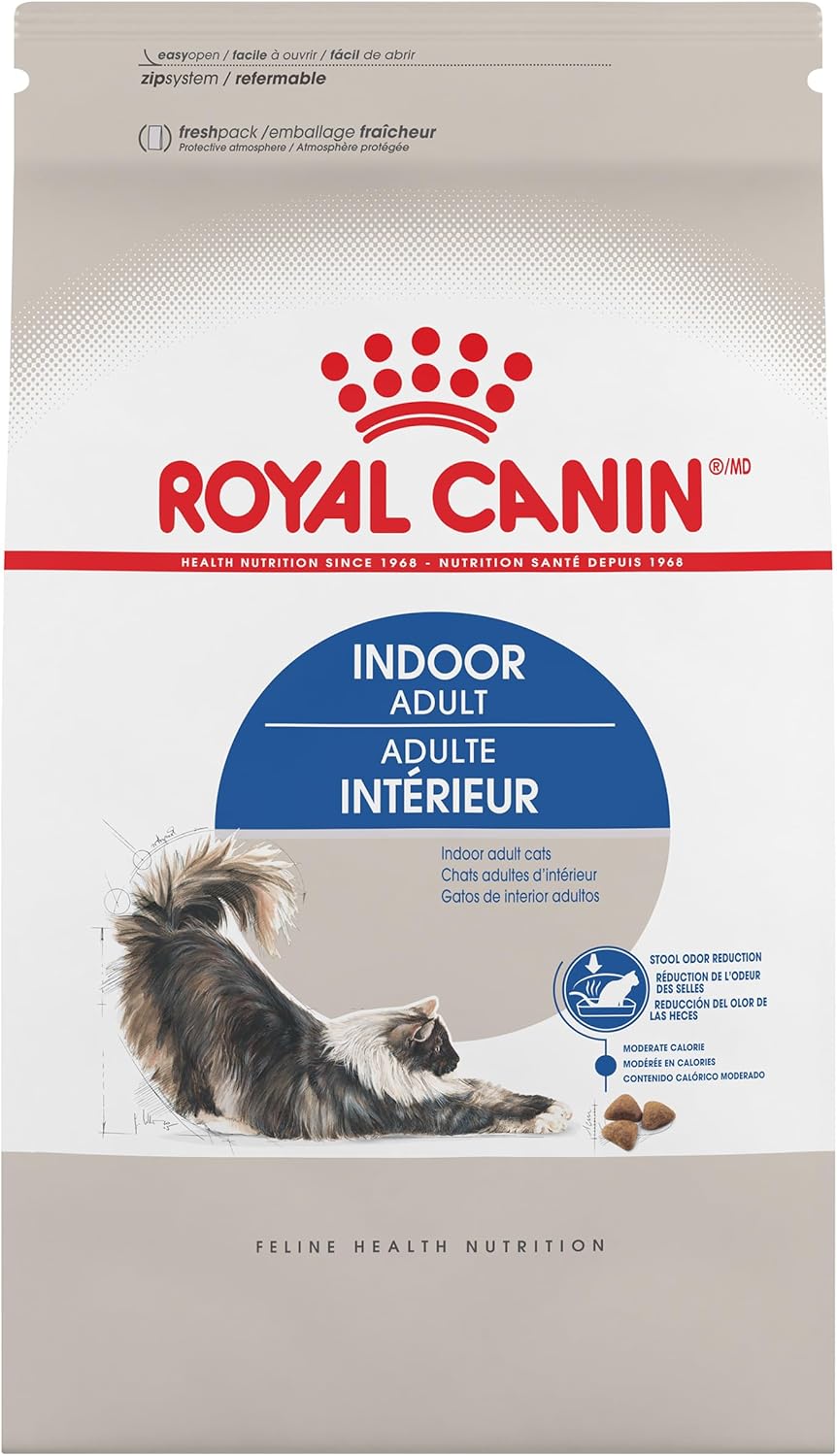
- For
- Indoor cats 1–7 years
- Fiber
- Hairball control blend
- Price
- $36.99 ($5.28/lb)
★ 4.7/5 from 7,204 verified Amazon reviews. The most single-minded formula in the group: every claim on the bag is about the indoor lifestyle. An optimal fiber blend helps ingested hair pass through the digestive tract instead of coming back up, controlled calories are matched to a leisurely indoor routine, and highly digestible proteins are there to improve stool quality – the "optimal cat stool" claim Royal Canin is known for. It is explicitly for cats aged 1 to 7, which is a useful boundary: senior cats should be on the 7+ version instead. At $5.28 per pound it is the most expensive food here, and for a heavy-shedding long-haired cat it is also the one most likely to earn that premium.
- Pros
- Most targeted hairball fiber blend in this list
- Digestibility focus shows up in stool quality
- Clear age band (1–7 years)
- Cons
- Highest cost per pound here
- Only 7 lb bags in this listing – frequent reordering
Blue Buffalo Tastefuls Chicken Adult Indoor Dry Cat Food, 10 lb
Best Natural
- Protein
- Real chicken first
- Bag size
- 10 lb
- Price
- $31.98 ($3.20/lb)
★ 4.7/5 from 13,268 verified Amazon reviews. The best value among the premium foods, and the one to pick if you want a natural formula without dropping to a budget brand. Real chicken is the first ingredient, the recipe is developed by veterinarians and animal nutritionists, and it includes Blue Buffalo's LifeSource Bits – a blend of antioxidants, vitamins and minerals formed at a lower temperature to preserve potency, which is the brand's signature. Ten pounds at $3.20 per pound costs less per meal than either vet-channel food while keeping a named meat first. Owners in the reviews consistently mention palatability, which matters: a natural food your cat refuses is more expensive than a premium one it eats.
- Pros
- Real chicken first at $3.20/lb
- 13,200+ reviews at 4.7/5
- Highly palatable – good for picky cats
- Cons
- LifeSource Bits get left in the bowl by some cats
- Less targeted hairball fiber than the vet brands
IAMS Proactive Health Indoor Dry Cat Food, 7 lb
Best Value Dry
- Protein
- Real chicken first
- Fiber
- Beet pulp blend
- Price
- $16.97 ($2.42/lb)
★ 4.8/5 from 39,822 verified Amazon reviews. The highest-rated food in the roundup and by far the largest review base – nearly 40,000 ratings at 4.8. Real chicken is the first ingredient, with turkey alongside it, and the formula includes a proprietary fiber blend built on beet pulp specifically to reduce hairballs before they form, plus prebiotics for digestion. IAMS calls the overall package its "Proactive 5" set of health benefits and is vet-recommended as a brand. At $2.42 per pound it costs less than half what the vet-channel foods do, which for a food you buy every six weeks is the difference between roughly $200 and roughly $450 a year.
- Pros
- 4.8/5 from nearly 40,000 reviews
- $2.42 per pound – best premium-to-price ratio
- Beet pulp fiber blend for hairballs
- Cons
- Contains corn and by-product meal – a dealbreaker for some owners
- Less calorie-controlled than dedicated weight formulas
Purina ONE Natural Indoor Dry Cat Food, 3.5 lb
Best Trial Size
- Protein
- Real turkey first
- Bag size
- 3.5 lb
- Price
- $10.28 ($2.94/lb)
★ 4.8/5 from 26,934 verified Amazon reviews. The cheapest way to find out whether your cat will eat a turkey-based indoor formula, and one of the highest-rated foods here. Real turkey is the first ingredient, the formula carries 10 percent less fat than Purina ONE's Tender Selects chicken blend, and a SmartBlend of fiber helps minimize hairballs while four antioxidant sources support the immune system. No artificial flavors or preservatives. The 3.5 lb bag is the point of this listing: it is a two-to-three week trial rather than a commitment, which is exactly what you want before buying a 16 lb bag of something your cat may refuse.
- Pros
- Low-cost trial size at $10.28
- Real turkey first, no artificial flavors or preservatives
- 4.8/5 from 26,900+ reviews
- Cons
- Highest per-pound cost of the budget group
- Small bag means frequent reordering if it becomes the staple
Purina Cat Chow Naturals Indoor Hairball Dry Cat Food, 13 lb
Cheapest per lb
- Protein
- Real chicken first
- Bag size
- 13 lb
- Price
- $15.99 ($1.23/lb)
★ 4.8/5 from 20,320 verified Amazon reviews. Thirteen pounds for $15.99 – about $1.23 per pound – with a 4.8 rating from more than 20,000 buyers. Real chicken is the first ingredient with real turkey alongside, the formula carries 25 essential vitamins and minerals, and it supports healthy weight for indoor cats. No artificial colors, flavors or preservatives, which is unusual at this price. For multi-cat households, fosters or anyone feeding several mouths on a fixed budget, this is the rational choice: it is complete and balanced adult nutrition at a quarter of the premium price. It is not a hairball therapeutic diet, despite the name – the fiber level is maintenance, not treatment.
- Pros
- $1.23 per pound – cheapest here by a wide margin
- No artificial colors, flavors or preservatives
- 4.8/5 from 20,000+ reviews
- Cons
- Grain-heavy formula compared with premium foods
- Hairball control is modest, not therapeutic
Royal Canin Indoor Adult Wet Cat Food, 24 × 3 oz
Best Wet
- Format
- Morsels in gravy, 3 oz pouches
- Pack
- 24
- Price
- $52.56
★ 4.6/5 from 647 verified Amazon reviews. The wet counterpart to the dry Royal Canin formula, and the pick for an indoor cat that needs more water in its diet. Morsels in gravy, formulated for cats aged 1 to 7, with highly digestible proteins for stool quality and a vitamin and mineral blend aimed at overall condition. It is explicitly suitable for spayed and neutered cats – relevant, because neutered indoor cats are the group most prone to weight gain. Royal Canin also points to an instinctively preferred protein-fat-carbohydrate ratio, which is the polite way of saying picky cats tend to accept it. The smallest review base in this roundup, but wet food is where premium brands earn their money.
- Pros
- High moisture – supports urinary health
- Suited to spayed and neutered cats
- Highly digestible, good stool quality
- Cons
- Expensive per meal
- Only 647 reviews so far
- 3 oz pouches are small for a large cat
Purina Friskies Indoor Wet Cat Food Variety Pack, 24 × 5.5 oz
Best Wet Value
- Format
- Pate cans, 5.5 oz
- Pack
- 24 cans
- Price
- $19.97
★ 4.6/5 from 17,524 verified Amazon reviews. Twenty-four 5.5 oz cans for $19.97, which is 132 ounces of food – about $2.42 per pound, the same per-pound price as a mid-range dry food but with three-quarters of the weight being water. That makes it the cheapest realistic way to add a wet meal to an indoor cat's day. Real poultry or seafood, complete and balanced for adult cats, no artificial colors or preservatives. The variety pack means you find out quickly which flavors your cat will actually finish, and the 5.5 oz can is a sensible size to split across two meals rather than leaving half a can in the fridge.
- Pros
- 17,500+ reviews at 4.6/5
- ~$2.42/lb for wet food – exceptional value
- Variety pack reveals preferences fast
- Cons
- Lower protein quality than premium wet foods
- Pate texture is refused by some cats
Comparison Table
| Product | Price | Size | Per lb | First ingredient | Rating |
|---|---|---|---|---|---|
| Hill's Science Diet Indoor 1-6 | $34.99 | 7 lb | $5.00 | Chicken | 4.7 / 16,517 |
| Royal Canin Indoor Adult Dry | $36.99 | 7 lb | $5.28 | Chicken | 4.7 / 7,204 |
| Blue Buffalo Tastefuls Indoor | $31.98 | 10 lb | $3.20 | Chicken | 4.7 / 13,268 |
| IAMS Proactive Health Indoor | $16.97 | 7 lb | $2.42 | Chicken | 4.8 / 39,822 |
| Purina ONE Indoor Advantage | $10.28 | 3.5 lb | $2.94 | Turkey | 4.8 / 26,934 |
| Cat Chow Naturals Indoor Hairball | $15.99 | 13 lb | $1.23 | Chicken | 4.8 / 20,320 |
| Royal Canin Indoor Wet | $52.56 | 24 × 3 oz | — | Meat in gravy | 4.6 / 647 |
| Friskies Indoor Wet Variety | $19.97 | 24 × 5.5 oz | ~$2.42 | Poultry / seafood | 4.6 / 17,524 |
How to Choose Food for an Indoor Cat
Judge the cat, not the label
Run your hands along the ribs: you should feel them under a thin layer of fat without pressing. Look from above – there should be a visible waist behind the ribs. If both checks pass, your cat does not need a reduced-calorie formula no matter what the bag suggests. If neither passes, the calorie level matters more than the brand, and portion control matters more than both.
Weigh the food instead of scooping it
Scoop volumes vary enormously between brands, and "one cup" of one kibble can weigh 30 percent more than "one cup" of another. A $15 kitchen scale removes the guesswork permanently. Feed to your cat's target weight, recheck body condition every two to three weeks, and adjust by 10 percent at a time rather than making big cuts.
Match the fiber to the hairball problem
If your cat produces a hairball more than once every few weeks, a formula with a stated hairball fiber blend – beet pulp, cellulose or psyllium – is worth trying for six to eight weeks. If hairballs continue at that rate on a hairball diet, or if the cat is short-haired and not a heavy shedder, it is a vet question rather than a food question.
Add water, one way or another
Indoor cats are chronically under-hydrated. A wet meal a day, a water fountain, or simply adding a tablespoon of warm water to the kibble all help. If you go the fountain route, remember the filter needs changing every two to four weeks – our fountain filter guide covers which pack fits which model.
Buy the bag size that matches your household
A 13 lb bag is a bargain for three cats and a stale liability for one. Dry food oxidizes once opened, and a single cat eating 7 lb of food takes six to eight weeks to finish a 7 lb bag – which is about the practical limit for freshness. Multi-cat homes should buy the biggest bag; single-cat homes should not.
FAQ
Do indoor cats really need a special food?
Not a special food, but a food matched to a different lifestyle. An indoor cat burns fewer calories than an outdoor cat of the same size, so it gains weight more easily, and it grooms more of its coat onto the carpet – which means more ingested hair. Indoor formulas respond to exactly those two problems: controlled calorie density and a fiber blend for hairball control. If your indoor cat is lean and hairball-free on a good all-life-stages food, there is no medical reason to switch.
Is wet or dry food better for indoor cats?
For hydration and weight control, wet food has the edge: it is roughly 75 to 80 percent water, which supports urinary health in cats that drink little, and it is easier to portion tightly. Dry food is cheaper, keeps longer and helps with plaque. The most practical answer for most indoor cats is both – a measured amount of dry food as the base and a small wet meal once or twice a day, with the total portioned to the cat rather than the bowl.
Do hairball control foods actually work?
They help, but they are not a cure. Hairball formulas use a specific fiber blend – often beet pulp, cellulose or psyllium – that helps ingested hair pass through the digestive tract instead of being vomited back up. Owners of long-haired and heavy-shedding cats consistently report fewer hairballs on these diets. What fiber cannot fix is over-grooming from stress, fleas or skin disease, so frequent hairballs in a cat that is not a heavy shedder is worth a vet visit.
How much should I feed an indoor cat?
Start with the feeding guide on the bag for your cat's target weight – not its current weight – then adjust every two to three weeks based on body condition. You should be able to feel the ribs easily without seeing them, and see a waist from above. A typical 10 lb indoor cat needs less than the bag suggests if it sleeps most of the day. Weigh the food with a kitchen scale instead of using a scoop; scoop sizes vary by 20 percent or more between brands.
How do I switch my cat to a new food?
Over seven to ten days: about 25 percent new food for the first two or three days, 50 percent for the next two to three, 75 percent after that, then all new food. Cats have sensitive guts and strong opinions, and a fast switch causes loose stools, vomiting or a refusal to eat. If your cat picks the new kibble out and leaves it, slow down. Never let a cat go more than 24 hours without eating – it can trigger hepatic lipidosis, a serious liver condition.
Bottom Line
Hill's Science Diet Indoor 1-6 is the safest default for an average indoor cat: the strongest professional backing, a clear digestive-fiber story and a coat claim that shows up in owner reviews. Royal Canin Indoor Adult is the one to try if hairballs are the recurring problem, and IAMS Proactive Health Indoor is the value pick that most households will actually stay on – 4.8 stars from nearly 40,000 reviews at $2.42 per pound. Add a wet meal from the Friskies variety pack for hydration, weigh the portions, and check body condition instead of trusting the bag.