Cat grass is one of the cheapest enrichments you can give an indoor cat: a tray of young wheat, oat or barley grass that takes four to six days to sprout and lives on a windowsill. Cats chew it, roll on it, and ignore it for a week – all normal.
This is a small category. Most cat grass products on Amazon have fewer than fifty ratings, and none of them have the review depth of a litter box or a fountain. Rather than dress that up, we have listed the actual rating counts next to each pick and focused on what you can verify: what is in the kit, whether the seed is certified organic, and how many grow cycles you get for the money.
| Product | Best For | Contents | Rating | Link |
|---|---|---|---|---|
| TCL Black Cat Mug Kit | Best Kit | Mug, coir disc, seeds | 4.6/5 (40) | Check Price |
| Organic Cat Grass Refill Kit | Best Refill | 3 seed packs + 3 soil pellets | 4.0/5 (34) | Check Price |
| Organic Wheatgrass Seeds (24 oz) | Best Bulk | 1.5 lb seed | 4.3/5 (22) | Check Price |
| House Tiger Refill 3-Pack | Best Coco Coir | 3 seeds, wicks, coir discs | 3.7/5 (6) | Check Price |
| Just Try Cat Grass Treats | Best Treat | 13.4 oz biscuits | 4.8/5 (12) | Check Price |
Why Cats Eat Grass
Nobody knows for certain. The two explanations owners repeat most are fiber – grass is roughly indigestible cellulose that adds bulk – and hairball management, since long blades can help move swallowed fur through the gut. What is clear is that grass is not a medicine and not a laxative; it is a cheap, safe thing for an indoor cat to chew instead of your houseplants.
It is also worth knowing what grass does not do. It does not "detox" a cat, it does not replace a fiber supplement, and it does not stop a cat eating a toxic plant if one is within reach. Think of it as enrichment with a mild digestive side effect, not a treatment.
What to Grow
"Cat grass" is not one species. Most kits use one or more of these:
- Wheatgrass – the most common, fast to sprout, thick blades.
- Oat grass – softer, sweeter, often preferred by cats that ignore wheat.
- Barley grass – fine blades, slower to establish.
- Rye grass – used in blends for density rather than flavour.
Any of them is fine. What matters is that the seed is untreated: garden seed is often coated with fungicide, which is exactly what you do not want a cat chewing.
The 5 Best Cat Grass Options
TCL Black Cat Mug Cat Grass Kit and Refill
Best Kit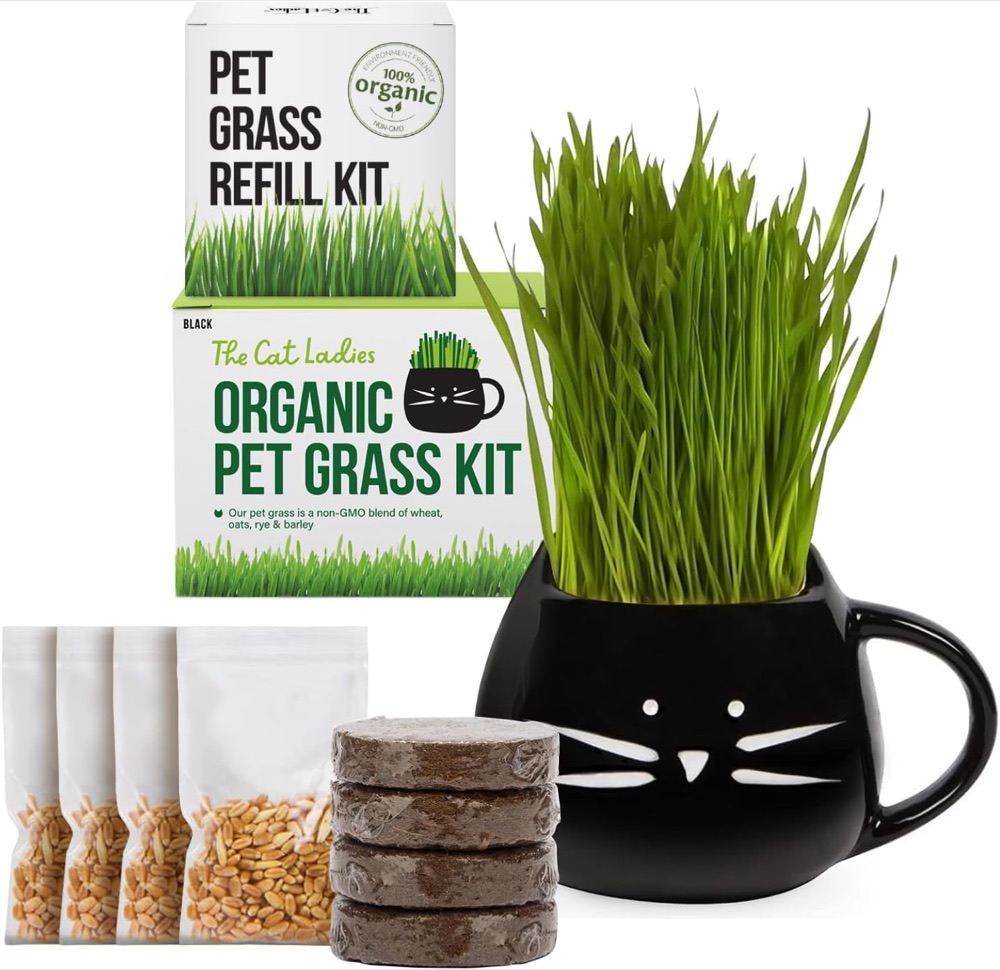
4.6/5 from 40 Amazon ratings. The best-presented kit here: a 4.7 x 5.5 x 6.1 inch ceramic mug with a cat-whisker design, one coconut coir disc and organic, non-GMO seed for wheat, oat, barley and rye. Coir holds water better than peat and does not go mouldy as fast, which is the usual failure point of cheap kits. The mug is the point of the product – it is reusable, so refills cost almost nothing, and it looks like a mug rather than a pet product on a windowsill.
- Pros
- Reusable ceramic planter
- Coco coir instead of peat
- Organic, non-GMO seed blend
- Gift-ready presentation
- Cons
- Only 40 ratings
- Single grow cycle per box
- Small – one cat, one tray
Cat Grass Refill Kit (Certified Organic, 3-Pack)
Best Refill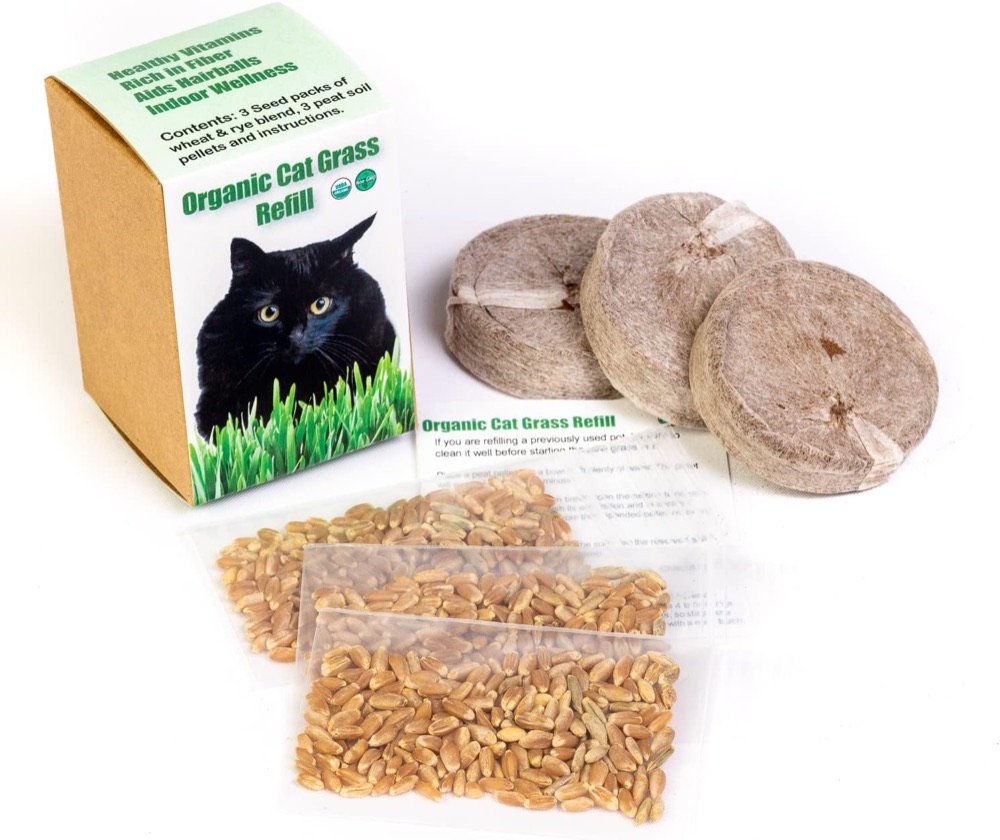
4.0/5 from 34 Amazon ratings. Three grow cycles with no planter, for anyone who already owns a pot. The seed is a certified organic wheat and rye blend, and each pack comes with a compressed peat pellet and instructions. The maker states the seed sprouts in four to six days and grows to roughly four to six inches – about right for a windowsill tray. Peat dries out faster than coir, so check moisture daily for the first week.
- Pros
- Three complete grow cycles
- Certified organic, non-GMO seed
- Works in any pot or tray
- Clear growing instructions included
- Cons
- Peat pellets dry out quickly
- No planter included
- Only 34 ratings
Organic Wheatgrass Seeds (24 oz / 1.5 lb)
Best Bulk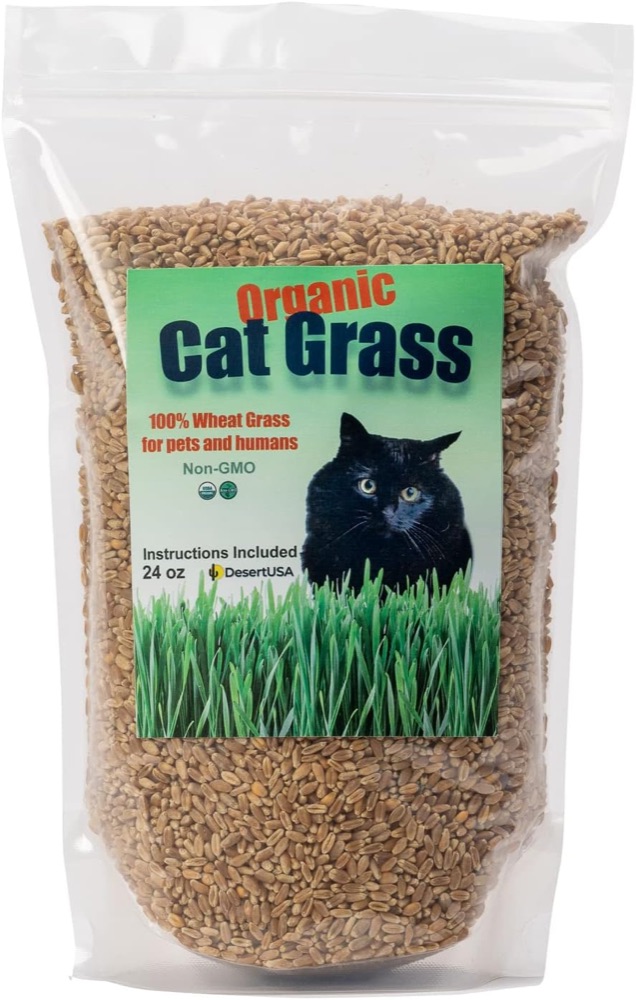
4.3/5 from 22 Amazon ratings. If you grow grass continuously, buy seed by weight rather than in kits. This is certified organic, non-GMO wheatgrass rated for both pet and human consumption – the same seed sold for juicing – and 1.5 lb fills a small tray many times over. The maker states germination in one to four days at 70°F or above. Store it dry and sealed; wheat seed loses viability quickly in a humid kitchen.
- Pros
- Much cheaper per grow cycle than kits
- Certified organic, food-grade seed
- Fast germination
- Works in any tray or pot
- Cons
- No soil or planter included
- Only 22 ratings
- Needs a warm spot to sprout
House Tiger Cat Grass Refill 3-Pack
Best Coco Coir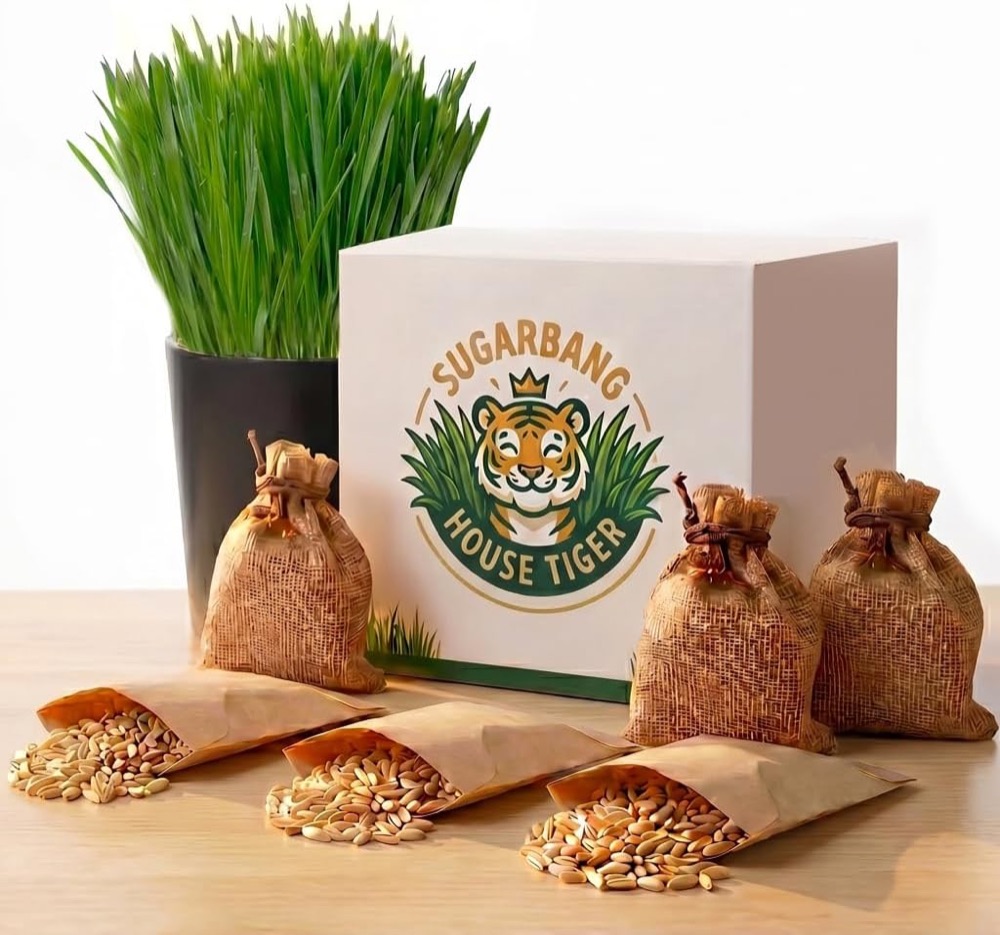
3.7/5 from 6 Amazon ratings. Included for one specific feature: the wicks. A refill pack with cotton watering wicks and coco coir discs is designed for self-watering planters, which solves the two things that kill indoor cat grass – drying out and drowning. The seed is US-sourced wheatgrass, untreated. The rating is the weakest here and based on only six reviews, so treat this as an option for a self-watering pot rather than a safe general buy.
- Pros
- Includes watering wicks for self-watering pots
- Coco coir discs, not peat
- Untreated US wheatgrass seed
- Three grow cycles
- Cons
- Only six ratings – very thin evidence
- Lowest rating in this guide
- Needs a compatible planter
Just Try Cat Grass Treats (13.4 oz)
Best Treat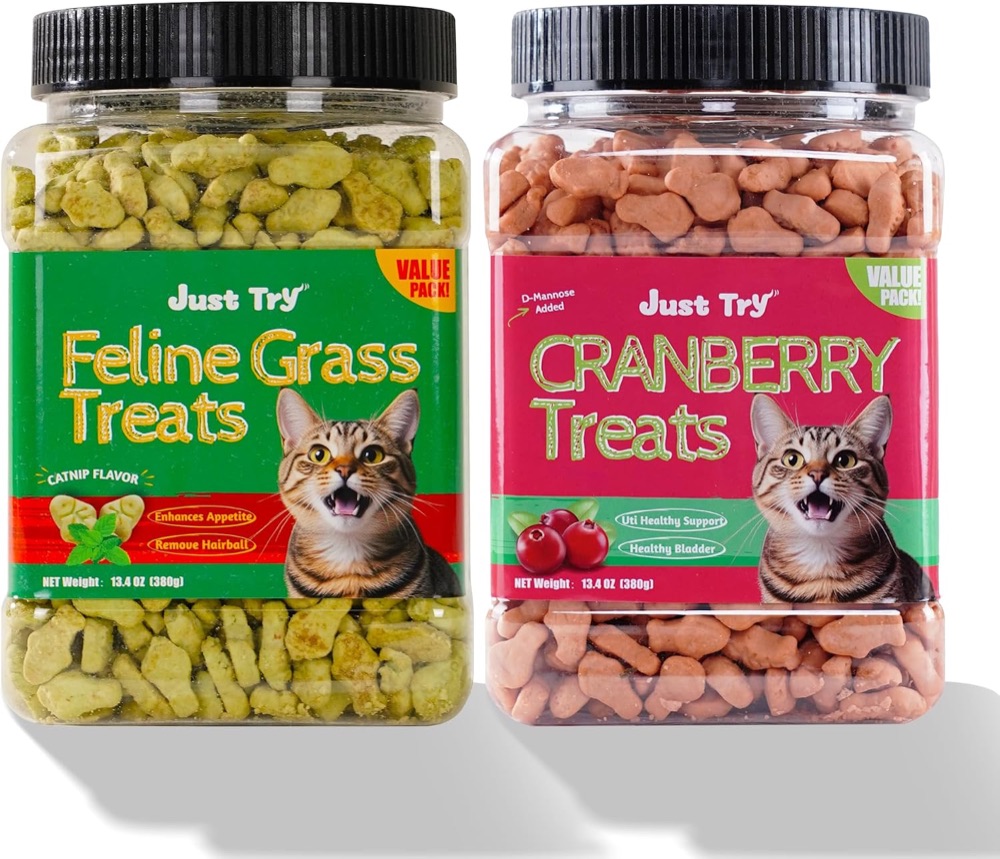
4.8/5 from 12 Amazon ratings. Not grass at all – a baked biscuit made with cat grass, salmon and catnip, for owners who want the fiber without a windowsill tray. Each treat is under 1.3 calories, which makes it usable as a training reward, and the crunchy texture does double duty on teeth. The catch is obvious: this is a processed treat, not fresh grass, and the rating rests on twelve reviews. Good as a supplement to a kit, not a replacement.
- Pros
- No growing, no mess
- Very low calorie per treat
- Crunchy texture helps with tartar
- Highest rating here
- Cons
- Processed treat, not fresh grass
- Only 12 ratings
- Contains salmon – not for fish-allergic cats
| Product | Type | Grow cycles | Planter included | Rating |
|---|---|---|---|---|
| TCL Black Cat Mug Kit | Kit | 1 | Yes (ceramic mug) | 4.6 (40) |
| Organic Refill Kit | Refill | 3 | No | 4.0 (34) |
| Organic Wheatgrass Seeds | Bulk seed | Many | No | 4.3 (22) |
| House Tiger Refill | Refill + wicks | 3 | No | 3.7 (6) |
| Just Try Grass Treats | Treat | — | — | 4.8 (12) |
Rating counts are as shown on Amazon on 27 October 2026. This is a small category – counts under 50 are normal and should be read as weak evidence.
How to Grow Cat Grass Indoors
- Soak the seed for six to eight hours before planting. It cuts germination time roughly in half.
- Fill a shallow tray two-thirds with moist soil or a rehydrated coir disc. Tamp it down but do not compact it.
- Scatter seed densely – close enough that blades support each other, then cover with a thin layer of soil, about a quarter inch.
- Keep it warm and damp at around 65–75°F. A windowsill is ideal; a dark cupboard is not. Mist daily for the first four days.
- Move it to light when blades appear, and water when the surface feels dry – not on a schedule.
- Offer it at about four inches, and replace the tray when it starts to yellow, usually after two to three weeks.
The most common failure is overwatering: soggy soil grows mould before it grows grass. The second is sowing too sparsely, which produces thin blades a cat ignores. If mould appears, throw the tray out – do not try to salvage it.
Safety Notes
- Untreated seed only. Garden seed is frequently coated with fungicide. Buy seed sold for sprouting or pet use.
- No pesticides, no outdoor grass. Lawn clippings and park grass carry herbicide and parasite risk. Indoor trays only.
- Grass is not a substitute for catnip – catnip is a different plant with a different effect, and roughly a third of cats do not respond to it at all.
- Vomiting after eating grass is common but not desirable. If your cat vomits every time, offer less grass, or stop.
- Houseplants are the real risk. Lilies, azaleas, sago palms and philodendrons are toxic to cats. Grass reduces plant-chewing, it does not prevent it.
Frequently Asked Questions
Is cat grass safe for cats?
Yes, when it is wheat, oat, barley or rye grown from untreated seed in clean soil. The risks are contamination, not the plant: pesticide-treated garden seed, outdoor grass with herbicide or parasites, and mould from overwatering. Rinse the tray and use fresh soil for each grow cycle.
Does cat grass help with hairballs?
It may help a little, because the fiber adds bulk and long blades can move swallowed fur along. It is not a hairball treatment. If your cat is bringing up hairballs more than occasionally, or is constipated, that is a vet conversation – and regular brushing does more than grass.
How often should I give my cat grass?
Offer a tray for ten to fifteen minutes a day, or leave it down and let the cat self-regulate. Most cats nibble briefly and walk away. Replace the tray when it yellows, typically every two to three weeks, and do not leave a mouldy tray out.
Can a cat eat too much grass?
Yes. A cat that gorges on grass will often vomit it back up, and long blades can irritate the throat. If yours eats until they are sick, put the tray down for short supervised sessions instead of leaving it out all day.
What is the difference between cat grass and catnip?
Cat grass is a cereal grass – wheat, oat, barley or rye – grown for chewing and fiber. Catnip is a member of the mint family, containing nepetalactone, which produces the rolling and rubbing reaction in roughly two-thirds of cats. They serve different purposes and are not interchangeable.
Bottom Line
For a first tray, buy the TCL Black Cat Mug Kit: everything you need in one box, a reusable planter, and coir that resists the mould problem. If you already have a pot, the Organic Cat Grass Refill Kit gives three cycles for less, and the 1.5 lb wheatgrass seed is the economical route once you know your cat will eat it.
The House Tiger refill only makes sense if you run a self-watering planter, and the Just Try treats are a convenience, not a substitute for fresh grass. Start small, sow densely, and do not overwater – that is the whole trick.