Cat trees range from 18 to 74 inches tall, and the right size is the difference between your cat's favorite piece of furniture and a dust-collecting tower your cat walks past. Size isn't a style question – it's the biggest factor in whether a tree is safe and gets used. A tree that's too tall for a kitten is a fall risk; a tree that's too small for a Maine Coon wobbles under a hard landing and gets abandoned.
To build this cat tree size guide, we pulled the specs – height, base dimensions, perch size, materials – from ten of the most popular cat tree models and cross-referenced them with more than 100,000 verified owner reviews. Every recommendation below is based on that data, on manufacturer specifications, and on established feline behavior and safety guidance. No sponsored rankings, no marketing claims.
| Product | Height | Key Benefit | Price Range | Link |
|---|---|---|---|---|
| Armarkat B5701 Real Wood 57-Inch Cat Tree | 57 in | Best Overall | $100–140 | Check Price |
| Armarkat Large 74" Cat Tree | 74 in | Best for High Ceilings & Multi-Cat | $130–170 | Check Price |
| FEANDREA 134 cm Cat Tree with Big Platform | ~53 in | Best Value | $60–90 | Check Price |
| Heybly Cat Tree with Toy, 43.3 inch | 43.3 in | Best Compact Mid-Height | $35–55 | Check Price |
| Trixie Baza Grande 24-in Cat Tree | 24 in | Best Low-Profile | $40–60 | Check Price |
| Catit Vesper Treehouse, Large | Large | Best Furniture-Grade | $150–210 | Check Price |
Why Cat Tree Size Matters More Than You Think
Cats are hardwired to climb, perch and scratch. In the wild, height means safety, which is why behaviorists recommend giving indoor cats vertical territory – and why a cat tree isn't optional in a multi-cat home. There's a physics side too: a 12-pound cat landing from a perch puts more than 50 pounds of force on a cat tree, and a 20-pound Maine Coon doubles that. Most cheap trees aren't built for it, failing in three predictable ways: perches too small to turn around on, a top platform that sways under a hard landing, and a tower that tips when the cat launches off it.
Wrong sizing is also a safety issue and a wasted investment. A tipping tower can injure the cat or break furniture – and a wobbly or cramped tree is one a cat will simply stop using, turning a $150 purchase into shelf clutter. Getting the size right the first time is cheaper than buying twice.
Cat Tree Sizes by Cat Type
There is no single "right" cat tree size, but there is a right size for each kind of cat:
| Cat type | Typical weight | Recommended height | Key sizing factor |
|---|---|---|---|
| Kitten (under ~12 months) | 2–12 lb, growing | 18–30 in starter, or adult-sized | Low platforms 10–16 in apart |
| Small / light breeds | 5–9 lb | 24–43 in | Compact platforms are fine |
| Average adult cat | 8–12 lb | 43–57 in | Platforms longer than body |
| Large breeds (Maine Coon, Ragdoll, Norwegian Forest, Siberian) | 12–25+ lb | 57–74 in (active) / 24 in (senior) | Wide base, big platforms, wall anchor |
Kittens: start low, plan for growth
Kittens are climbing machines, but their bones and coordination are still developing. A low starter tree in the 18–30 inch range, with platforms no more than 10–16 inches apart, keeps jumps safe for growing joints. Kittens also grow fast – most reach roughly 75–90% of their adult size within their first year – so either buy a tree sized for the adult cat and let the kitten grow into it, or start with an affordable low model. Either way, insist on good sisal coverage: kitten scratching habits form early, and sisal beats your sofa.
Small and light cats: compact is fine
Small breeds like Singapuras, Munchkins and petite females don't need a tower built for a Maine Coon. A 24–43 inch tree with compact platforms gives a light cat all the vertical territory it needs, for less money and floor space. The main thing to check is stability: light cats still jump and launch, and a tall, narrow tree can tip even under a 7-pound cat if the base is too small. The Trixie Baza Grande (24 in) and Heybly (43.3 in) are solid fits here.
Average adult cats: the 43–57 inch sweet spot
For the most common household cat – a healthy adult in the 8–12 pound range – a tree between 43 and 57 inches is the sweet spot: real climbing range and a perch high enough to survey the room, without the tipping risk or ceiling problems of the tallest towers. The key detail is perch size: platforms should be longer than the cat's body so it can stretch out and turn around. The Armarkat B5701 (57 in) and FEANDREA 134 cm (~53 in) get this right most consistently in our analysis.
Large breeds: big platforms and a wide base beat raw height
Maine Coons, Ragdolls, Norwegian Forest Cats and Siberians aren't just heavier – they're longer, stronger and more confident jumpers, with bodies long enough that an average cat platform is barely a place to sit. For young, active large breeds, a 57–74 inch tower works, but only if the perches fit a full stretched-out body and there's a low pause platform near the top landing zone. For older or less agile large cats, a low 24-inch structure is safer and still covers scratching and lounging. In every case: base at least 20 inches deep, real wood construction, and use the wall anchor.
How Tall Should a Cat Tree Be? Height Recommendations
Here's the short answer, in inches and centimeters:
| Height | In cm | Best for |
|---|---|---|
| 18–24 in | 46–61 cm | Kittens, seniors, low-activity cats |
| 24–43 in | 61–109 cm | Small cats, compact apartments |
| 43–57 in | 109–145 cm | Most adult cats |
| 57–74 in | 145–188 cm | Active large breeds, multi-cat homes |
Match height to your cat's age and jumping confidence
The most reliable way to choose a height is to work backwards from your cat. A young, energetic cat with a confident jump will use every inch of a 57- or 74-inch tower. A senior cat, a cat with arthritis, or a cautious cat is often happier on a low 24-inch structure it can step onto without jumping. Watch how your cat moves: if it jumps confidently onto counters and shelves, it will use height; if it prefers the floor, buy low.
Ceiling height math
Before you buy a tall tree, do the ceiling math. Standard US rooms have 96-inch (8 ft) ceilings, leaving about 22 inches of clearance above a 74-inch tree – and a cat on the top perch adds roughly another 10. In rooms with lower or sloped ceilings, that 74-inch tower becomes a hazard. The 57-inch class fits comfortably under virtually any ceiling.
A stability rule of thumb
A commonly used guideline: the base of a freestanding tower should be roughly one-third of its height in depth – the Armarkat B5701's 28×25-inch base, on a 57-inch tree, exceeds that comfortably. If a tree's base is much narrower than a third of its height, treat the height as marketing and the stability as the real spec. For anything over 50 inches, or any cat over 15 pounds, add the wall anchor.
Multi-cat households: height is territory
In multi-cat homes, height is conflict management. Cats resolve most disputes by avoiding each other, and separate perches at different heights give each cat its own escape route and lookout. This is the one case where going taller than the single-cat recommendation makes sense: the Armarkat 74-inch tower is built around this idea.
Footprint & Stability: Base Width Beats Height
Physics is unforgiving: a cat launching from a high perch creates leverage a narrow base can't counter. The base – not the height – determines whether a tree tips. For every inch of height above about 40, you want more base depth, not more perches.
A good base is wide and deep in both directions – the Armarkat B5701's 28×25-inch footprint is our benchmark. Square bases resist tipping better than round ones, because the corners add leverage against the tip direction. And the base material should grip the floor: carpet or a non-slip coating makes a real difference on hardwood and tile.
For tight spaces, a low center of gravity does the stability work. The Trixie Mexia's 15.75×15.75-inch base and the Catit Vesper Small's 14.57×14.57-inch base are about the footprint of a floor lamp, and at 29 and 28.5 inches tall they're inherently harder to tip than any tower. Low and wide is always the safest combination.
Materials: What Holds Up at Each Size
Size and materials are two halves of the same equation. A tall tree made of thin particle board is a wobble risk even with a wide base; a short tree of solid wood is nearly indestructible. Three places matter most.
Posts and frame
Real wood or thick engineered-wood posts hold up far better than thin particle board – the difference between trees that last 3–5 years and trees that sag within months. Real wood is heavier, which sounds like a con until you realize the weight is doing stability work for you. Expect 45–90 minutes of assembly, ideally with two people.
Sisal coverage
Sisal-wrapped posts take the most abuse – it's the scratching surface, and cats scratch hard. Look for thick sisal on all main posts – a tree with one token sisal post and plush everywhere else gets shredded within months. Sisal is also the first thing to wear out: with a large cat, expect 6–18 months of heavy use. Look for replaceable posts, or plan to re-wrap them – new sisal is far cheaper than a new tree.
Perches and condos
Plush is fine for perches and condos – it's what makes them comfortable for napping – but it's not a substitute for sisal where your cat actually scratches. For large cats, pay extra attention to platform attachment: the most common large-cat complaint in owner reviews is a wobbly top platform, and that's a quality issue, not a size issue.
Placement: Where to Put a Cat Tree
The right tree in the wrong spot performs half as well. A few simple rules cover most homes.
Corners are the structural cheat code. A tree in a corner gets two walls of support, which dramatically reduces wobble and uses floor space that's otherwise wasted. If you have a tall tree and a corner available, that's where it belongs.
Windows are the second-best spot. Cats are professional window-watchers, and a tree near a window gives hours of stimulation while reducing boredom-driven scratching. Keep it clear of radiators and direct sun, which can overheat a napping cat and bake the fabric.
Match the room to the cat. Shy cats want a quiet room where they can watch without being approached; confident cats are happy in the family traffic. In multi-cat homes, spread trees across separate rooms or corners so every cat has its own territory and a clear escape route – and give the top perch a view of the entrances.
Leave doorways and paths clear. A tree that only fits if it blocks a door, radiator or closet will end up dismantled within a month. Measure at floor level – the base is usually wider than the tower – and check the swing of nearby doors and windows.
Our Size-Based Picks
These are the models from our analysis that best fit each size category. Specs, prices and ratings are from manufacturer data and verified Amazon owner reviews at the time of writing.
Armarkat B5701 Real Wood 57-Inch Cat Tree
Best Overall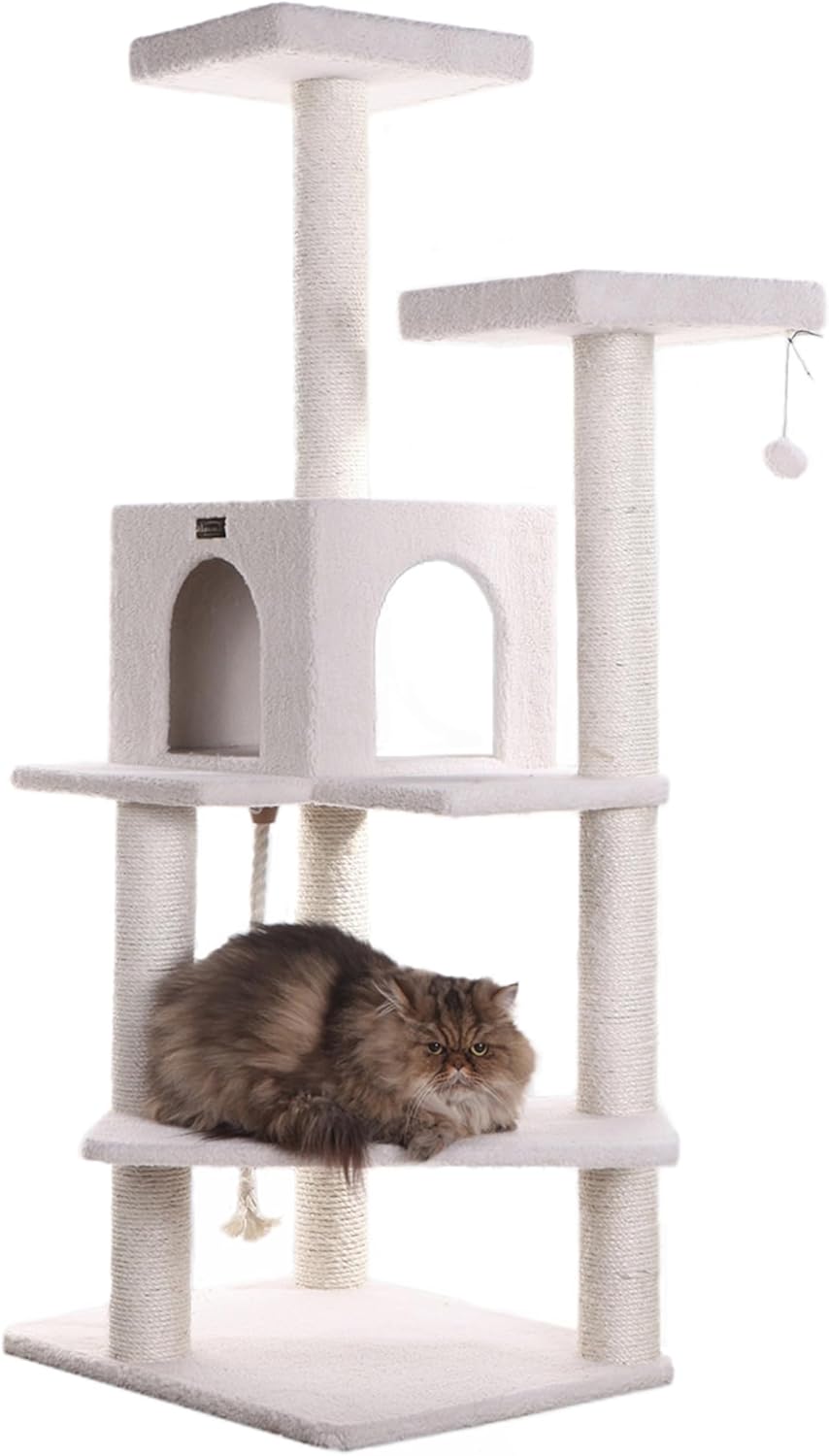
- Material
- Wood
- Price range
- $100–140
★ 4.6/5 from 19,535 verified Amazon reviews. The most-reviewed tall real-wood cat tree in our analysis – and the model that hits the 43–57 inch sweet spot for adult cats and large breeds at once. The 57-inch height gives a big cat real climbing range, while the 28×25-inch base exceeds the one-third-of-height stability guideline and the real wood construction addresses the two failure points that plague cheap towers: tipping and wobbling. With nearly 20,000 reviews, it also has the most long-term data in this guide.
- Pros
- Real wood construction – sturdier than particle board towers
- 57-inch height suits adult cats and large breeds
- Wide 28×25-inch base for stability
- 19,500+ reviews = proven long-term track record
- Cons
- Mid-to-high price point
- Heavy – plan for two-person assembly
Armarkat Large 74" Cat Tree
Best for High Ceilings & Multi-Cat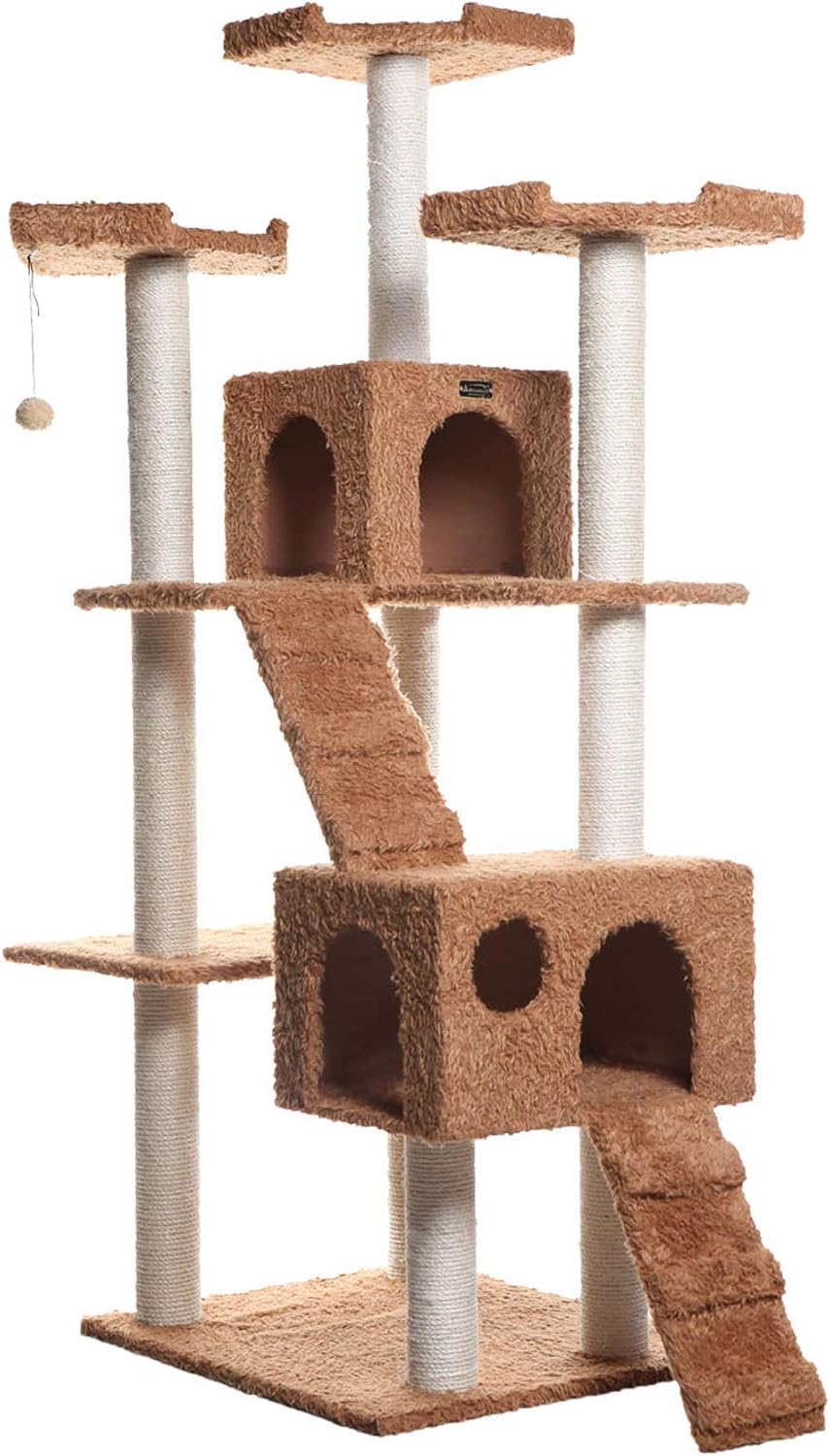
- Price range
- $130–170
★ 4.7/5 from 1,521 verified Amazon reviews – the highest average rating in our analysis. At 74 inches, it's the tallest tree we reference, built for the two situations where extra height genuinely pays off: multi-cat households needing separate perches, and high-ceiling homes. The built-in cat house gives a big cat a den-sized hideaway. If your ceilings are standard 8 feet, do the clearance math first – this tower needs the room.
- Pros
- Tallest model in our analysis – 74 inches of climbing space
- Highest average rating: 4.7/5
- Real wood construction
- Enough perches for two cats to nap apart
- Cons
- Check your ceiling height before buying
- Large footprint and heavy – dedicated assembly time
FEANDREA 134 cm Cat Tree with Big Platform
Best Value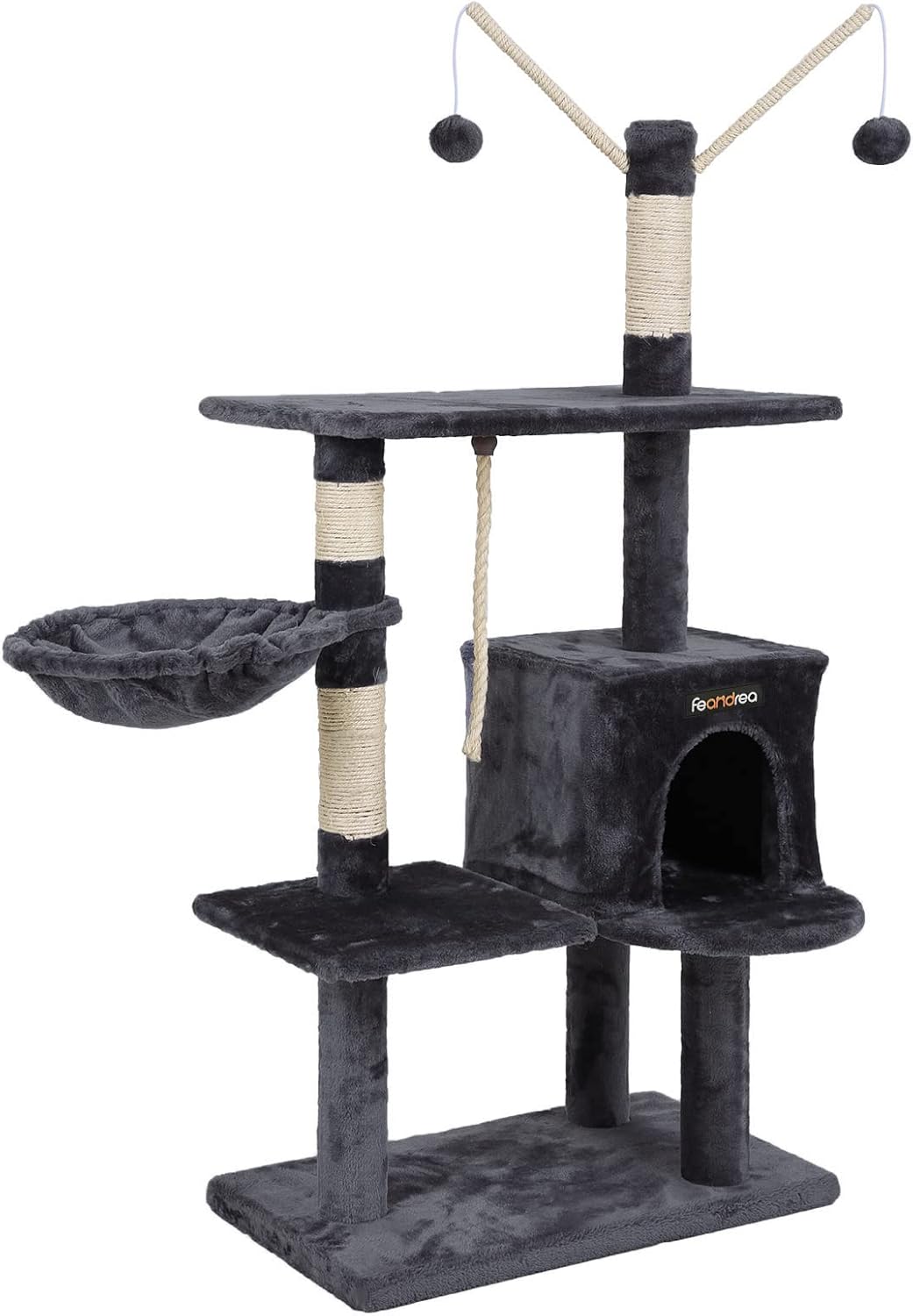
- Price range
- $60–90
★ 4.6/5 from 3,328 verified Amazon reviews. FEANDREA is one of the most popular value brands in cat furniture, and this 134 cm (~53-inch) tower lands in the middle of the adult-cat height range at well under $100. Its big platform is designed for a stretched-out body – the perch-size factor that matters most – and two cat houses cover hide-and-nap behavior. It won't out-spec the Armarkat towers, but at roughly half the price it delivers most of what an adult cat needs, which is what makes it the best value pick.
- Pros
- Big platform suits stretched-out bodies
- Combines scratching posts, houses and perches
- Well under $100 – strong value
- Solid 4.6/5 from 3,300+ reviews
- Cons
- Shorter than the tall Armarkat towers
- Plush surfaces need regular vacuuming
Heybly Cat Tree with Toy, 43.3 inch
Best Compact Mid-Height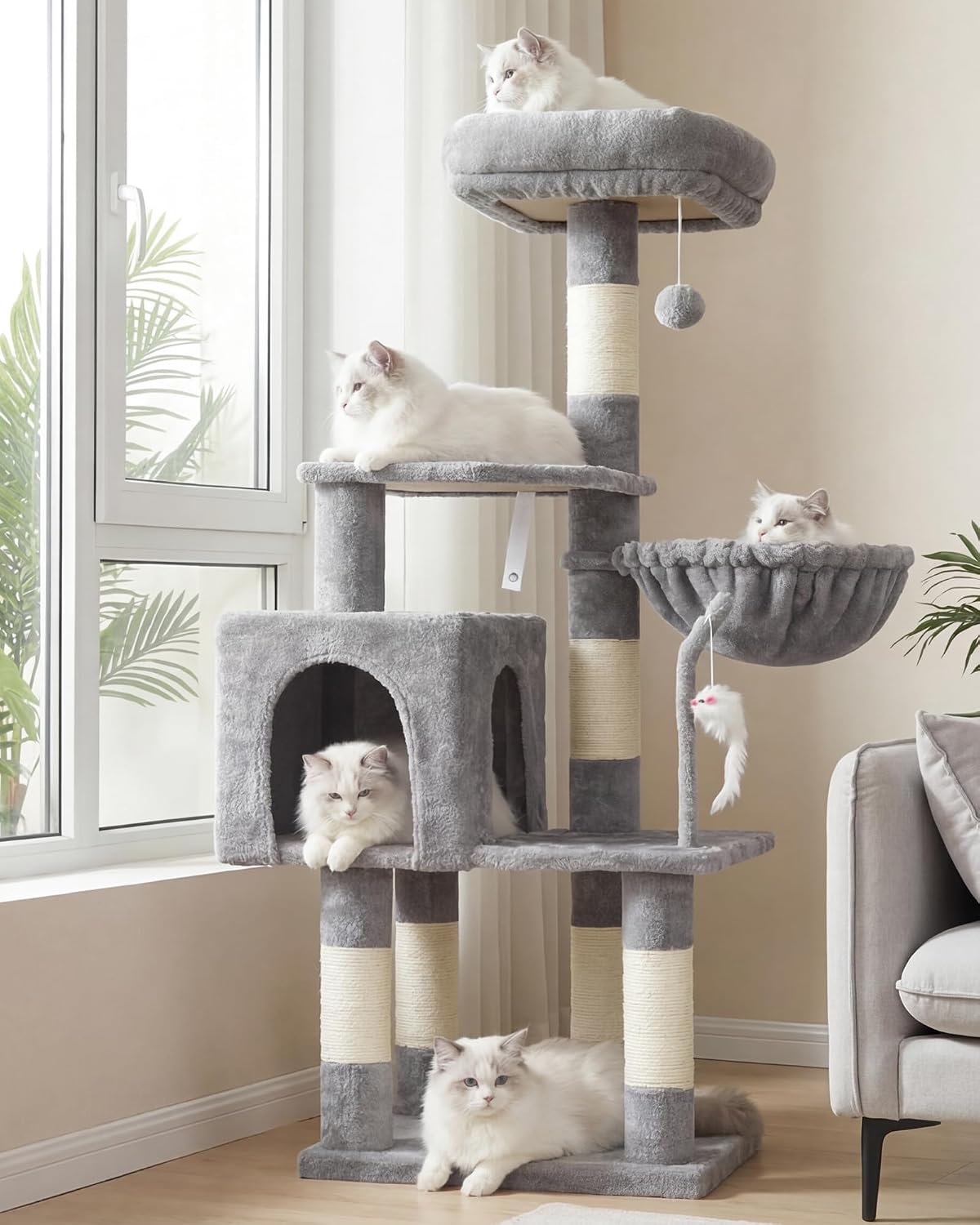
- Price range
- $35–55
★ 4.2/5 from 7,758 verified Amazon reviews. The Heybly answers the classic size question: you want the 43–57 inch range for an adult cat, but the room won't fit a wide tower. At 43.3 inches it sits at the bottom of the adult range with a footprint modest enough for a corner, packing a plush perch, a hammock, a sisal post and a hanging toy into the package. It's also a bridge size for kittens growing into adulthood, and its 7,758 reviews make it the most-tested compact tower in our analysis.
- Pros
- 43.3 inches of climbing range in a compact footprint
- Perch, hammock, sisal post and toy in one package
- Budget-friendly with 7,700+ reviews
- Fits corners and tight spots
- Cons
- Lighter build – anchor it for energetic cats
- Not tall enough for enthusiastic climbers
Trixie Baza Grande 24-in Cat Tree
Best Low-Profile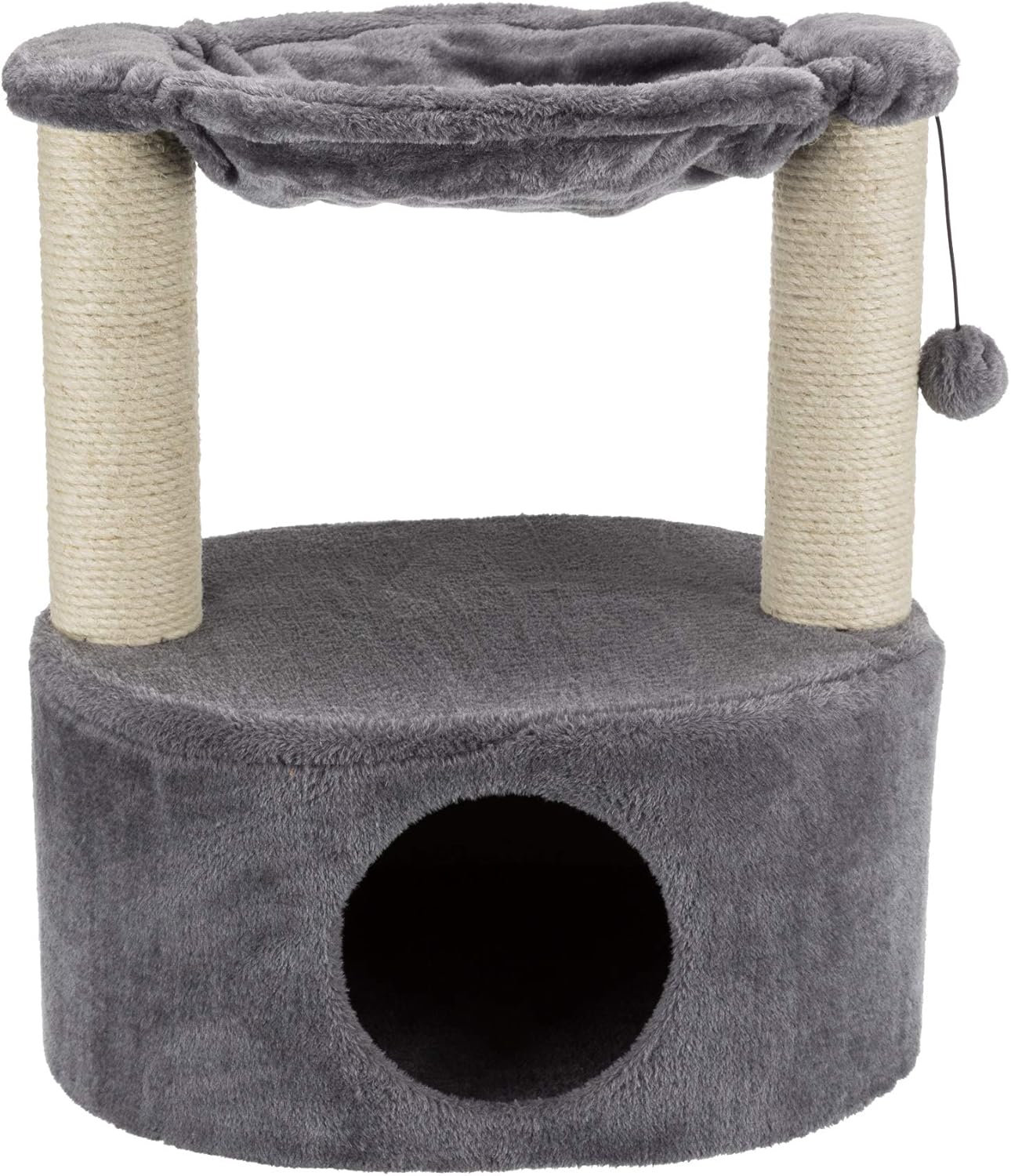
- Price range
- $40–60
★ 4.2/5 from 54,878 verified Amazon reviews – by far the largest owner base in this guide, and one of the most-reviewed cat trees on Amazon, period. This ground-hugging 24-inch design with two sisal posts and a cat condo is the low-profile philosophy: ideal for kittens, senior cats, and large breeds who prefer lounging over climbing or have joint issues that make high jumps risky. With nearly 55,000 reviews, there is more real-world data on this model than anything else we looked at.
- Pros
- Budget price with a massive track record
- Low height = safe for kittens, seniors and less agile cats
- Two sisal posts for scratching
- 54,878 reviews – unmatched real-world data
- Cons
- 24-inch height won't satisfy tall climbers
- Perches are compact compared to tower platforms
Full Comparison: Height, Footprint & Price
| Model | Price | Height | Footprint | Best for |
|---|---|---|---|---|
| Armarkat B5701 | $100–140 | 57 in | 28×25 in | Overall |
| Armarkat 74" | $130–170 | 74 in | Large | High ceilings, multi-cat |
| FEANDREA 134 cm | $60–90 | ~53 in | Big platform | Value |
| Heybly 43.3" | $35–55 | 43.3 in | Compact | Compact mid-height |
| Trixie Baza Grande | $40–60 | 24 in | Low profile | Budget / low-height |
| Trixie Mexia | $50–70 | 29 in | 15.75×15.75 in | Tiny footprint |
| YUNIQUE Tower | $40–60 | 39.4 in | 22.4×13.8 in | Multi-feature |
| Catit Vesper Small | $100–150 | 28.5 in | 14.6×14.6 in | Modern compact |
| Catit Vesper Large | $150–210 | Large | Furniture-grade | Modern large |
| What's Mew Shelf | $20–40 | Wall-mounted | 20×10 in shelf | Zero floor space |
FAQ
How tall should a cat tree be?
For a typical adult cat (8–12 lb), a tree between 43 and 57 inches (109–145 cm) covers most households. Kittens and small cats do best at 24–43 inches (61–109 cm), young active large breeds like Maine Coons benefit from 57–74 inches (145–188 cm), and senior or less agile cats are safer on a low 24-inch structure. Match the height to your cat's age, weight and jumping confidence – not the tallest tree that fits the room.
What size cat tree does a Maine Coon need?
Young, active Maine Coons need a 57–74 inch tower with platforms big enough for a full stretched-out body and a low pause platform near the top landing zone. Older or less agile large cats are safer on a low 24-inch structure. Whatever the height, look for a base at least 20 inches deep, real wood construction, and use the included wall anchor.
What size cat tree is best for a kitten?
Kittens do best starting on a low tree (18–30 inches) with platforms no more than 10–16 inches apart, so jumps stay safe for growing bones. Because kittens reach roughly 75–90% of their adult size within their first year, many owners buy a tree sized for the adult cat and let the kitten grow into it – or start with an affordable low model.
How much floor space does a cat tree need?
Compact models sit on bases of about 14×14 to 22×14 inches – roughly the size of a floor lamp – while tall, wide towers like the Armarkat B5701 use a 28×25-inch footprint. Measure the corner at floor level (the base is usually wider than the tower) and check door and window swing before buying.
Is a taller cat tree always better?
No. Height only helps if the base is wide enough to keep the tree stable and your cat is confident enough to use it. A tall, narrow tower tips under a hard landing, and repeated high jumps can strain the joints of senior or arthritic cats. A stable 57-inch tree is worth more than an 80-inch tree that wobbles.
Should I anchor my cat tree to the wall?
Yes – especially for trees over 50 inches tall or cats over 15 pounds. The anchor strap is cheap, takes minutes to install, and eliminates the worst-case scenario of a tipped tower hitting a cat, furniture or a window. It's the single cheapest safety upgrade you can make.
Bottom Line
Size your cat tree backwards from your cat: kittens start low and grow into an adult-sized tree, small cats are happy at 24–43 inches, average adults do best at 43–57 inches, young large breeds need 57–74 inches with big platforms, and seniors of any breed are safer on a low 24-inch structure.
Whatever the height, base width, perch size and construction quality beat height every time. The Armarkat B5701 is the safe all-round pick for most households, the Armarkat 74" covers high ceilings and multi-cat homes, the FEANDREA 134 cm is the value pick, the Heybly fits tight rooms, the Trixie Baza Grande covers kittens and seniors, and the Catit Vesper Large is the furniture-grade option. A stable 57-inch tree that doesn't wobble is worth more than an 80-inch tree that tips.
